

Business Operation · 2025
In this section23 topics
- Corporate Information4 items
- Dividend Policy2 items
- Major Shareholders3 items
- Business Strategies Overview7 items
- Material Changes & Developments1 item
- Use of Proceeds from Securities Offerings3 items
- Commitments Made in the Registration Statement1 item
- Group Operating-Structure Policy1 item
- Companies Where the Company Holds ≥10%1 item
- Shareholders with Potential Conflict of Interest1 item
- Relationships Among Major Shareholders1 item
- Shareholders' Agreement1 item
- Shareholding Diagram (Group Structure)1 item
- Income Structure3 items
- Product / Service Characteristics2 items
- Research & Development5 items
- Assets Used in the Business7 items
- Marketing Policy & Competition3 items
- Procurement of Products & Services2 items
- Nature of Business — Overview1 item
- Projects Under Construction1 item
- Debentures & Bills of Exchange1 item
- Convertible Securities1 item
Corporate Information
Company Name
THITIKORN PUBLIC COMPANY LIMITED
Telephone
0-2310-7000
Website
www.tk.co.th
investor@tk.co.th
Dividend Policy
Dividend Policy
Thitikorn’s dividend payment policy to the shareholders is to pay dividends at the rate of not exceeding 60% of net profit after tax (Consolidate).
For the dividend payment of the subsidiary companies, dividends shall be paid at the rate of not less than 30% of the net profit after tax of each year
The Company's financial performance, cash flow, capital requirements for business expansion, or others will be considered to facilitate the Company's payment of dividends. Payment of dividends is subject to approval of the General Shareholders’ Meeting; interim dividend payment may be approved by the Board of Directors and acknowledged by the next General Shareholders’ Meeting.
Historical Dividend Payments
| This Year | Last Year | 2 Years Ago | 3 Years Ago | 4 Years Ago | Metric | Description |
|---|---|---|---|---|---|---|
| -0.03 | 0.18 | 0.73 | 0.94 | 0.74 | Net profit per share (Baht : Share) | Net profit per share (baht : share) |
| 0.2 | 0.25 | 0.42 | 0.5 | 0.42 | Dividend per share (Baht : Share) | Dividend per share (baht : share) |
| 0 | 0 | 0 | 0 | 0 | Dividend stock ratio (Number of original shares: dividend shares) | Ratio of stock dividend payment (existing share : stock dividend) |
| 0.2 | 0.25 | 0.42 | 0.5 | 0.42 | Dividend share value per share (Baht : Share) | Value of stock dividend per share (baht : share) |
| 0.2 | 0.25 | 0.42 | 0.5 | 0.42 | Total dividend payment value (Baht : Share) | Total dividend payment (baht : share) |
| -629.3 | 135.7 | 57.2 | 53 | 57.1 | Dividend payout ratio to net profit (%) | Dividend payout ratio compared to net profit (%) |
Business Strategies Overview
Introduction
The Board of Directors realizes the importance of the business operation and, therefore has participated in the establishment of the corporation’s vision/mission, objectives, and strategies including the company’s directions to be appropriate for the business competition.
In 2025, at the Board of Directors meeting dated 12 November 2025, Directors and Management reviewed and determined the Company’s vision and mission for executives and staff to achieve the same goals. The organization's vision/mission is reviewed annually (or as appropriate) to respond to current economic circumstances.
Chairman's Message
In 2025, the Thai economy and the global economy continue to face both challenges and opportunities. This is set against the backdrop of a gradual recovery of the world economy following the turbulence caused by the COVID-19 pandemic, geopolitical conflicts, and persistently high inflation in recent years. Nevertheless, the overall global economic outlook has become more stable, supported by more accommodative monetary policies in several major countries and the adaptation of businesses to align with the structure of the modern economy.
Thai economy in 2025 grew by 2.4%, slightly lower than the 2.5% growth recorded in 2024. This slowdown was mainly due to the impact in the second half of the year from a decline in tourist arrivals, border conflicts between Thailand and Cambodia, and flooding in the southern region, although the government introduced several stimulus measures in 2025, such as the Khon La Khrueng co-payment scheme and cash handouts for people with disabilities and holders of state welfare cards, domestic spending remained subdued. Household consumption, in particular, was constrained by high household debt burdens and uneven income recovery. Nevertheless, Thailand’s economy continued to be supported by key drivers: tourism, investment from both the public and private sectors, and exports. These factors contributed to a significant improvement in service sector income. The number of international tourists stood at 32.9 million, a 7.2% decline from 2024. This marked the first drop in four years, with tourism revenue totaling 1.53 trillion baht, down 4.7% from 2024. On the investment side, the government continued to play a key role through infrastructure projects and the promotion of targeted industries (New S-Curve). Meanwhile, private sector investment began to recover. Foreign direct investment in Thailand in 2025 reached 324 billion baht, the highest in five years, and 42% higher than in 2024, particularly in industries linked to regional supply chains, production relocation, and technology and innovation driven sectors. In 2025, Thailand’s total export value reached USD 340 billion, representing an expansion of 12.9% compared to 2024. This marked the highest export level on record, driven primarily by accelerated shipments amid uncertainties surrounding the United States’ reciprocal tariff measures and increasing signs of uncertainties in international trade policies.
In terms of monetary policy, policy interest rates of major economies worldwide are beginning to trend downward to support economic growth and reduce the financial burden on businesses and households. By 2025, the US Federal Reserve cut its policy interest rate a total of three times throughout the year, by a total of 75 basis points (bps), from 4.25% - 4.50% at the end of 2024 to 3.50% - 3.75% at the end of 2025, the lowest level in three years. The European Central Bank (EU) has kept its benchmark interest rate at 2.0% at the end of 2025, after eight consecutive cuts. As for the Bank of Thailand, it cut its policy interest rate four times in 2025, by a total of 100 basis points, from 2.25% at the end of 2024 to 1.25% at the end of 2025, to stimulate the economy which has slowed due to declining consumption and the impact on the slow down of the thai economy in the second half of the year.
In 2025, the hire purchase and retail lending industry continued to face challenges from persistently high household debt levels and increasingly stringent regulatory requirements. This follows the enactment of the Royal Decree prescribing that automobile and motorcycle hire purchase and leasing businesses be subject to the Financial Institutions Business Act B.E. 2551 (2008), B.E. 2568 (2025), which became effective on December 3, 2025. In addition, the regulations, conditions, and supervisory measures governing hire-purchase and leasing businesses issued by the Bank of Thailand, including the Responsible Lending guidelines, sustainable household debt resolution measures, and the interest rate and fee ceilings, will be strictly enforced beginning June 1, 2026. These developments require companies to exercise greater prudence in credit approval processes and debt collection practices, which may affect the future growth of the hire purchase business.
In 2025, motorcycle market sales totaled 1,735,366 units, increasing by 1.6%, marking a return to growth after a contraction in the previous year. Meanwhile, automobile market sales reached 621,166 units, rising by 8.5%, the first expansion after two consecutive years of decline. The company remains committed to prudent risk management policies, prioritizing credit quality over quantitative expansion. Operational processes have been adjusted to comply with regulatory requirements, while ensuring fair and sustainable treatment of customers. Net hire purchase and loan receivables stood at 1,624.8 million baht, a decrease of 18.5%. Domestic motorcycle hire purchase receivables amounted to 358.0 million baht, down 53.2%, while automobile hire purchase receivables were 186.3 million baht. Hire purchase receivables in Laos and Cambodia totaled 934.2 million baht, a decline of 1.1%, representing 57.5% of the company’s net hire purchase and loan receivables. At the end of 2025, the company has cash, deposits, and financial assets of 3,524.6 million baht, accounting for 62.5% of total assets, with a debt-to-equity ratio of 0.06 times.
Over the past year, the company emphasized strong liquidity and financial stability, alongside operational efficiency, cost control, and internal system development. Digital technology has been adopted to enhance management, customer service, and good corporate governance. The company continues to seek opportunities for international expansion, particularly in ASEAN countries, which hold long-term growth potential. The Board of Directors recognizes that long-term sustainability is not measured solely by financial performance, but must also encompass responsibility to all stakeholders. Therefore, the company places importance on conducting business under the ESG framework, covering environmental, social, and governance dimensions while fostering employee development, organizational transparency, and responsible growth for society.
Finally, on behalf of the Board of Directors, I would like to express my gratitude to shareholders, investors, customers, business partners, financial institutions, the Securities and Exchange Commission, as well as all executives and employees, for their dedication and continuous support. I am confident that with a solid financial foundation, prudent management, and collective cooperation, the company will overcome challenges and achieve sustainable growth in the future. May all sacred powers bless our shareholders and stakeholders with happiness, success, and good health always.

Dr. Chumpol Phornprapha
Chairman
Vision
To be the leasing company for retail customers in the region that creates sustainable growth together with our customers, economy, and society.
Objectives
We provide accessible and responsible microfinance services to support the sustainable growth of our customers and the economy. We are committed to developing the potential of our employees and enhancing the quality of our services to build satisfaction and trust with our customers and business partners. We conduct our business under the principles of good corporate governance, while also considering society, the community, and the environment.
Goals
Thitikorn Public Company Limited (the Company) focus on motorcycle hire-purchase which is Thitikorn core competency. The Company's strategy is to expand coverage areas by setting up new branches in major provinces outside Bangkok and the vicinity area as well as expanding into ASEAN. In 2014, two subsidiary companies were set up to provide motorcycle and automobile hire-purchase in two countries which are Cambodia and Laos. In addition, a subsidiary company with a registered capital of 50 million Baht was established in 2015 to operate a Nano financing business.
For the automobile hire-purchase business, the Company emphasizes providing its services in Bangkok and the vicinity area for efficient customer management and cost control while business expansion depends on market conditions, competition, risks, and rate of return.
The Company concentrates on the quality of the hire-purchase portfolio as well as the rate of return while growth is based on manageable and controllable risks. With a standardized customer screening process and stringent policy for loan loss reserve, the Board of Directors, Independent Directors, and the Management also placed great importance on Good Corporate Governance to formulate policies and procedures to ensure sustainable returns to all shareholders. Information disclosures and explanations are sufficiently provided to all institutional investors, analysts, and shareholders since the management team places a priority on such mission in order to allow equal access to accurate information regarding the Company’s performance and operations.
Long-term Goal
1. Regularly maintain the dividend payment not exceeding 60% of the net profit from the consolidated budget after income tax deduction and legal reserve deduction
2. Maintain more than 85% employee satisfaction
3. Conduct the business plan with 100% consideration of the environment, society, and corporate governance.
In addition, the Company utilized existing knowledge and business base to enhance competitiveness and gave importance to environment, society, and corporate governance care in order to achieve the goal of sustainable organization. Senior executives conveyed the plan to executives and employees at all levels monitored strategy implementation to the set goals and reported progress to the Board of Directors.
Business Strategies
TK provides several services to satisfy different customer needs as follows:
1. Fast service with accuracy and efficiency
TK has on-site credit officers to provide service for customers. Those officers can notify customers of the credit approval within 90 minutes for motorcycle hire-purchase and 1 day for automobile hire-purchase. Once the hire-purchase contract has been approved, the Company can immediately make payment to the good record dealers.
2. Excellent relationship with business alliances
TK and business alliances, motorcycle, and car dealers, have maintained an excellent relationship with trustworthiness for more than 50 years, therefore, new customer and business promotion can effectively be introduced through this relationship. Those relationships can be considered as an advantage over the competitors.
3. Various payment channels
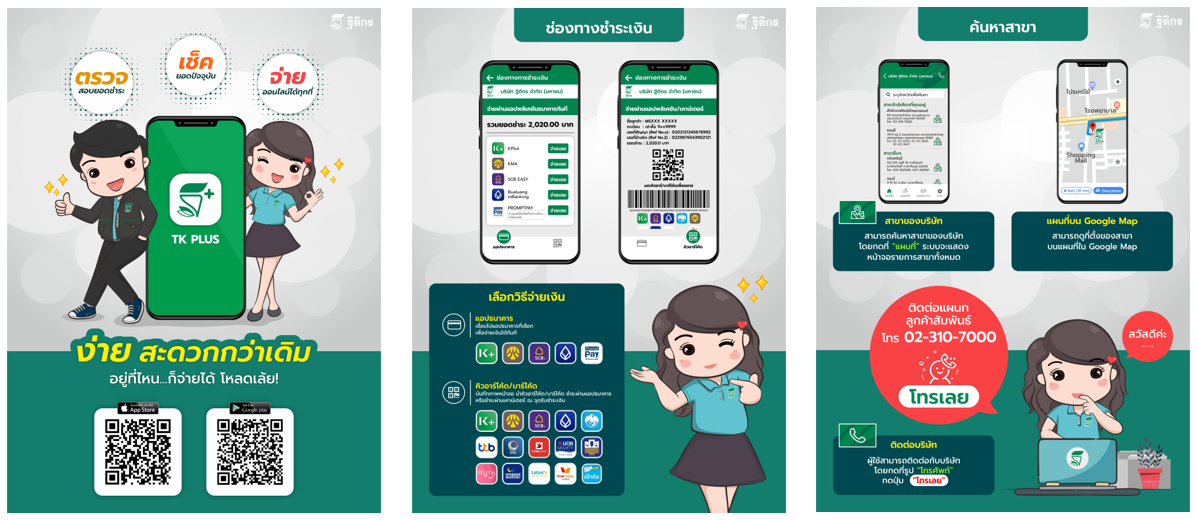
For the convenience of our customers, the Company has increased many new payment channels. The customers can pay the installments through commercial banks, company branches, collection officers, Tesco Lotus, Internet Banking, True Money, and Counter Service, and pay points at convenience stores throughout the country
4. Onsite credit officer and collection officer service
TK has on-site credit officers and collection officers covering various areas in Bangkok and vicinity and provincial to service all customers effectively. Since local officers have more familiarity with customers in the area, loan approval, and collection process can be efficiently monitored.
5. Human resource development
TK has provided regular training programs to update the employees on market situations for effective and single-standard services. As a result, the company can offer services to all customers on time with efficiency and less risk.
6. Being a member of Motorcycle and Automobile Hire-purchase Association
TK is a co-founder of the Thai Motorcycle Hire-purchase Association, as a member of both Motorcycle and Automobile Hire-purchase Associations, the Company can share necessary industry information for regular operational standard development.
Pricing policy
The Company has no policy to compete on price but rather sets appropriated interest rate depending on factors such as cost of fund, type, model, brand, condition, and age of the vehicle including qualifications of customers and guarantors.
Distribution channel
To approve the hire-purchase contract, the customer can apply for service through 3 different channels such as:
(1) Contact dealers or sub-dealers alliances
(2) Contact credit officer
(3) Contact company headquarters or branches
(4) Communication was facilitated through the TK Plus application.
Approximately 95% of the Company's business came from dealers and sub-dealers under a win-win strategy for all parties while good relationships have been maintained. As a result, the number of business alliances has been increased annually.
Since 2001, the Company has gradually increased its number of branches from 27 branches at the end of 2001 to 48 branches in 2025 covering 41 provinces in every region of Thailand.
Other Information
| Name | Description |
|---|---|
| Mission | To focus on creating corporate cultures and values of good corporate governance by adhering to the principles as follows;
|
| Values |
|
Material Changes & Developments
Material Changes & Developments
| Year | Description |
|---|---|
| 1,972 |
|
| 1,995 |
|
| 2,000 |
|
| 2,002 |
|
| 2,003 |
|
| 2,011 |
|
| 2,012 |
|
| 2,014 |
|
| 2,015 |
|
| 2,017 |
|
| 2,019 |
|
| 2,020 |
|
| 2,021 |
|
| 2,022 |
|
| 2,023 |
|
| 2,024 |
|
| 2,025 |
|
Use of Proceeds from Securities Offerings
Is There Money Raised from a Securities Offering Still to Report On?
Yes
Offerings
| Type of Securities | Type — Please Specify | Amount Raised Given As | Amount Raised (Million Baht) | Uses of the Money | Used as Declared? | Progress / Reasons and Measures if Not Used as Declared |
|---|---|---|---|---|---|---|
| Other | Debenture | 2873 | 400 | 2022-07-19 · Objective: For loan repayment and/or as working capital. · Period type: 2869 · Start period: 2019-07-19 · Spent amount type: 2873 · Start spent amount: 400.0 · Expected amount type: 2873 · Start expected amount range: 400.0 | Y | The Company repaid some original debentures in the amount of 400 million Baht and spent 200 million Baht from the operation, paid in full. |
| Other | Debenture | 2873 | 600 | 2021-02-23 · Objective: For loan repayment and/or as working capital. · Period type: 2869 · Start period: 2018-02-23 · Spent amount type: 2873 · Start spent amount: 600.0 · Expected amount type: 2873 · Start expected amount range: 600.0 | Y | The Company repaid the loans and interests to financial institutions in full. |
| Other | Debenture | 2873 | 70 | 2021-09-05 · Objective: Repaid the loans or debts from issuing bonds. · Period type: 2869 · Start period: 2018-09-05 · Spent amount type: 2873 · Start spent amount: 70.0 · Expected amount type: 2873 · Start expected amount range: 70.0 | Y | The Company repaid the loans and interests to financial institutions in full. |
| Other | Debenture | 2873 | 150 | 2019-09-21 · Objective: Repaid the loans or debts from issuing bonds. · Period type: 2869 · Start period: 2018-09-21 · Spent amount type: 2873 · Start spent amount: 150.0 · Expected amount type: 2873 · Start expected amount range: 150.0 | Y | The Company repaid the loans and interests to financial institutions in full. |
| Other | Debenture | 2873 | 1,000 | 2020-02-28 · Objective: For the repayment of loans, including debentures due for redemption and borrowings from financial institutions, excluding loans from the debenture underwriters, and/or as working capital. · Period type: 2869 · Start period: 2017-02-28 · Spent amount type: 2873 · Start spent amount: 1000.0 · Expected amount type: 2873 · Start expected amount range: 1000.0 | Y | The Company repaid the original debentures in the amount of 900 million Baht in full. |
| Other | Debenture | 2873 | 800 | 2020-08-18 · Objective: For loan repayment and/or as working capital. · Period type: 2869 · Start period: 2017-08-18 · Spent amount type: 2873 · Start spent amount: 800.0 · Expected amount type: 2873 · Start expected amount range: 800.0 | Y | The Company repaid the loans and interests to financial institutions in full. |
Law Governing the Debt Securities
Applicable laws for the issue and offer of securities for sale are Thai laws including Securities and Exchange Act B.E. 2535, and other regulations or announcements related to such laws.
Commitments Made in the Registration Statement
Are There Commitments or Conditions from an Offering or Listing?
No
Group Operating-Structure Policy
Description
The company has established oversight guidelines for its group companies to control management and protect the company's interests. This is achieved by appointing company personnel to senior management positions in subsidiaries to ensure consistent operational direction. The company requires subsidiaries to disclose financial reports and related party transactions in accordance with relevant rules and regulations. Furthermore, the executive committee holds regular meetings to monitor and report on the performance and oversight of its subsidiaries.
Companies Where the Company Holds ≥10%
Companies (≥10% Holding)
| Company Name | Address | Province | Zip Code | Telephone | Business Type | Security Type | Shares | Paid-up Shares |
|---|---|---|---|---|---|---|---|---|
| C.V.A. Company Limited | 69 Ramkhamhaeng Rd., Huamark, Bangkapi | Bangkok | 10240 | 0-2310-7000 | Provides services in connection with motorcycle hire-purchase business, including debt collection and vehicle rebuilt services. | Common shares | 50,000 | 50,000 |
| Chayapak Company Limited | 71 Ramkhamhaeng Rd., Huamark, Bangkapi | Bangkok | 10240 | 0-2310-7000 | Automobile Hire-Purchase | Common shares | 40,000 | 40,000 |
| Suosdey Finance PLC | No.117, 119 & 121, Russian Federation Blvd., Phum Trong Moan, Sangkat Ou Baek K’am, Khan Saensokh, Phnom Penh, Cambodia. | (855) 023-884455 | Motorcycle and Automobile Hire-Purchase | Common shares | 4,000,000 | 4,000,000 | ||
| Sabaidee Leasing Co., Ltd | 077, Thaduea Road Unit 05, Ban Buengkayong Srisattanak, Vientiane Capital, Lao PDR | (856) 021-316422 | Motorcycle and Automobile Hire-Purchase | Common shares | 1,906,250 | 1,906,250 | ||
| TK Ngern Tan Jai Co., Ltd | 71 Ramkhamhaeng Rd., Huamark, Bangkapi, | Bangkok | 10240 | 0-2310-7000 | Nano Finance | Common shares | 50,000 | 50,000 |
| TK BROKER Co., Ltd | 69 Ramkhamhaeng Rd., Huamark, Bangkapi, | Bangkok | 10240 | 0-2310-7000 | Non-life insurance broker | Common shares | 30,000 | 30,000 |
Income Structure
Product / Service Income
| Category | Description | This Year | This Year % | Last Year | Last Year % | 2 Years Ago | 2 Years Ago % |
|---|---|---|---|---|---|---|---|
| Total revenue from operations | Total revenue from operations | 902,936 | 100 | 1,295,661 | 100 | 1,653,931 | 100 |
| Motorcycle Hire-purchase | 414,146 | 45.86 | 697,662 | 53.85 | 1,190,543.79 | 71.98 | |
| Automobile Hire-purchase | 14,047 | 1.56 | 13,903 | 1.07 | 14,099.03 | 0.85 | |
| Loans | 20,912 | 2.32 | 22,386 | 1.73 | 17,433.69 | 1.05 | |
| Motorcycle rental business | 83,883 | 9.29 | 93,641 | 7.23 | 1,533.85 | 0.09 | |
| Others | 369,948 | 40.97 | 468,069 | 36.12 | 430,320.15 | 26.02 | |
| Other | Other | 0 | 0 | 0 | 0 | 0.49 | 0 |
Export Income
| Category | Description | This Year | This Year % | Last Year | Last Year % | 2 Years Ago | 2 Years Ago % |
|---|---|---|---|---|---|---|---|
| Total revenue | Total revenue from operations | 902,936 | 100 | 1,295,661 | 100 | 1,653,931 | 100 |
| Domestic | Domestic | 469,815 | 52.03 | 793,072 | 61.21 | 1,078,399.5 | 65.2 |
| International | International | 433,121 | 47.97 | 502,589 | 38.79 | 575,531.5 | 34.8 |
| Cambodia | Cambodia | 360,381 | 83.21 | 425,343 | 84.63 | 518,173.56 | 90.03 |
| Laos | Laos | 72,740 | 16.79 | 77,246 | 15.37 | 57,357.7 | 9.97 |
| Myanmar | Myanmar | 0 | 0 | 0 | 0 | 0 | 0 |
| Other countries | Other countries | 0 | 0 | 0 | 0 | 0.24 | 0 |
Other Income
| Operating Other Income | Non-Operating Other Income | Share of Profit |
|---|---|---|
| 1710 · As of year: 369948.0 · Description: Total other income · As of yesteryear: 468069.0 · As of year before yesteryear: 431854.0 · 1711 · As of year: 317521.0 · Description: Other income from operations · As of yesteryear: 426139.0 · As of year before yesteryear: 395485.0 | 1712 · As of year: 52427.0 · Description: Other income not from operations · As of yesteryear: 41930.0 · As of year before yesteryear: 36369.0 | 1713 · As of year: 0.0 · Description: Share of profit · As of yesteryear: 0.0 · As of year before yesteryear: 0.0 |
Product / Service Characteristics
Business Type
3115
Business Groups
| Business Group | Description | ||||||||||||||||||||||||||||||||||
|---|---|---|---|---|---|---|---|---|---|---|---|---|---|---|---|---|---|---|---|---|---|---|---|---|---|---|---|---|---|---|---|---|---|---|---|
| Hire purchase business | Hire purchase is another form of financial service under the supervision of the Bank of Thailand (BOT) like banks and finance companies. However, the persons involved in providing hire-purchase service consist of 3 parties: (1) customers or buyers, (2) dealers, and (3) companies or credit service providers. When a hire-purchase buyer wants to buy an asset from a dealer, he or she shall express his or her desire to the credit officer of the credit service provider to check the eligibility and approve the loan application. When the buyer agrees to enter into the contract, the buyer will pay the down payment on the contract date and determine the payment method for the period stipulated in the contract. The buyer can possess and use the asset throughout the duration of the contract and is responsible for maintaining the asset. The ownership of the asset will be transferred to the buyer after the installments are fully paid to the credit service provider according to the contract. For the hire-purchase service of the Group, the nature of the business can be divided by type of hire-purchase assets as follows: 1. Motorcycle hirepurchase business The Group provides motorcycle hire-purchase service by Thitikorn Public Company Limited, focusing on hire-purchase service for motorcycles that are popular among consumers such as Honda and Yamaha. The Company shall assign loan officers to consider lending to buyers on each motorcycle at motorbike shops that are business partners. Factors in determining credit limit, down payment, and installment period depend on customers' financial status including brand, model, and price of motorcycles. It was found that the Group has provided hire-purchase service for major motorcycle brands such as Honda and Yamaha. 2. Automobile hirepurchase business The Group provides automobile hire-purchase service for both new and used automobiles by Chayaphak Company Limited, a subsidiary, mainly focusing on hire-purchase service for automobiles, the models and brands of which are popular in the market, such as Toyota, Isuzu, and Honda, etc. The credit limit and the period of installment payment for automobiles depend on the financial status of each loan applicant. In providing credit service, the Group also considers other factors such as adequate down payment to control the quality of credit. As for the new automobile hire-purchase service, the Group focuses on Japanese automobiles, especially Toyota which is very popular in the market. According to the usage of automobiles, the Group’s automobile hire-purchase service can be classified into car hire purchase and commercial vehicle hire purchase (type of vehicles that buyers want to use for the business of trading such as pick-up trucks and vans). The balance of automobile hire-purchase receivables of the Company Group is classified by type of vehicle use*. (Unit: Million Baht)
* After deducting deferred hire-purchase profit and VAT, before deducting allowance for doubtful accounts | ||||||||||||||||||||||||||||||||||
| Nano-Finance Business | Nano-finance business for occupation under supervision or nano-finance is lending or hire purchase to individual customers with the purpose of business without any documents certifying income or assets pledged as collateral. The Company will consider whether the customer has a settled career and a clear occupational income or not so their workplace and income will be examined and assessed as evidence for credit applications. For nano-finance, the BOT stipulates that the maximum rate of interest, fines, service charges, or fees, in the amount, when summing up, not exceed 36 percent (Effective rate) for the contracts arising from January 23, 2015, onwards and not exceed 33% per annum for contracts arising from August 1, 2020, whereby the Company started providing nano-finance service since February 3, 2016. In the year 2022 - 2025, the Company’s revenue came from nano-finance business in the proportion of 0.44 : 0.19 : 0.16 : 0.07 percent of total income, respectively. | ||||||||||||||||||||||||||||||||||
| Vehicle Title Loan Business | A personal loan business with a vehicle registration book as collateral, or a vehicle title loan, provided services to general customers. The company accepted the vehicle registration book as collateral for payment of the debt. The customer still holds ownership and can use the vehicle. The company considers credit limits when granting loans by mainly taking into account the needs of customers and the current value of the collateral. In addition, the company will inspect and assess customers’ income and income stability. The BOT vehicle title loans set the maximum rate of interest, fines, service fees, or fees combined not to exceed 24 percent per year at the Effective Rate. The company has been providing vehicle title loans since July 2022. In 2022–2025, the company's income from vehicle title loans was approximately 0.01 : 0.80 : 1.54 : 2.04 percent of total income, respectively. | ||||||||||||||||||||||||||||||||||
| Vehicle Rental Business | A motorcycle rental business under the name “TK Me” is a monthly or weekly service for motorcycle use, which is an alternative for consumers who want to use a motorcycle but do not want to own a property. It helps increase convenience for motorcycle consumers to use it easily, including expanding the customer base to the new generation market. The company has started providing motorcycle rental services since January 2024. In 2024-2025, the company's income from vehicle title loans was approximately 7.2 : 9.3 percent of total income. | ||||||||||||||||||||||||||||||||||
Research & Development
Has R&D Policy (Y/N)
No
R&D Cost — Label
Research and development (R&D) expenses over the past 3 years (Million Baht)
R&D Cost — This Year
0.0
R&D Cost — Last Year
0.0
R&D Cost — 2 Years Ago
0.0
Assets Used in the Business
Introduction
The main assets used in the operation of the Group are as follows:
Permanent Assets — Description
These are tangible assets acquired for use in the Company’s operations, such as land, buildings, vehicles, and office equipment. They have an estimated useful life of 5 to 20 years, are recorded at cost, and are depreciated over their useful lives in accordance with the Company’s accounting policies.
The main fixed assets of the Company and its subsidiaries used for business operations as of December 31, 2025
Permanent Assets — Appraisal
| Asset | Ownership | Obligation | Appraisal Value | Description |
|---|---|---|---|---|
| Land | Owner | - | 12.6 | Unit: Million Baht |
| Buildings | Owner | - | 0 | Unit: Million Baht |
| Vehicle | Owner | - | 8.6 | Unit: Million Baht |
| Office Equipment | Owner | - | 2.7 | Unit: Million Baht |
| Utilities | Owner and lease | - | 0.5 | Unit: Million Baht |
| Office Renovation | Owner | - | 13.4 | Unit: Million Baht |
| Building Improvements | lease | - | 12.2 | Unit: Million Baht |
| Computer Equipment | Owner | - | 1.8 | Unit: Million Baht |
| Hand Tools | Owner | - | 0 | Unit: Million Baht |
| Investment Property – Land | Owner | - | 12.8 | Unit: Million Baht |
| Investment Property – Building | Owner | - | 2.9 | Unit: Million Baht |
| Investment Property – Motorcycles | Owner | - | 102.1 | Unit: Million Baht |
| Leasehold Chanthaburi Branch Office No. 183/6-7 Trirat Road Chanthanimit Subdistrict, Mueang Distric | 3-year lease 1 Sep.23–31 Aug.26 Rental fee 12,000 baht/month | - | 0 | Unit: Million Baht |
| Non-performing assets | Owner | Land valued at 1.7 million Baht and buildings valued at 2.5 million Baht located in Pathum Thani Pro | 12.8 | Unit: Million Baht |
Intangible Assets — Description
These assets are acquired to enhance operational efficiency and are expected to generate benefits, with controlled access and restricted availability, such as computer software systems. They are recorded at cost and amortized over their estimated useful lives in accordance with the Company’s accounting policies.
Intangible assets used by the Company and its subsidiaries in conducting their business as of December 31, 2025.
Intangible Assets — Appraisal
| Asset | Type | Appraisal Value | Description |
|---|---|---|---|
| Computer System | Software | 0.2 | Unit: Million Baht |
Has Subsidiaries Investment Policy (Y/N)
Yes
Subsidiaries Investment Policy — Description
The Company has a long-term investment policy in all six subsidiaries, each of which has a committee to jointly formulate policies and strategies that shall be implemented by the management of each subsidiary. The main policy of all six subsidiaries must be approved by the Board of Directors.
Marketing Policy & Competition
Reporting Mode
3117
Marketing Policy (Overall)
Customer Characteristics
The target customers for the motorcycle hire-purchase business of the Company Group are general individuals who are employees or permanent workers with low to middle incomes and use motorcycles as their vehicles or for career enhancement.
For the automobile hire-purchase business, the target customers are divided by the purpose of use, i.e. private cars and commercial vehicles. At the end of 2024, the Group's proportion of private cars to commercial vehicles was 48 : 52.
Industry & Competition (Overall)
1. Motorcycle Hire-purchase business
In 2025, the motorcycle hire-purchase business remains highly competitive, driven by captive finance companies affiliated with motorcycle manufacturers, large consumer finance operators with low-cost funding sources, and small to medium-sized local operators with close customer relationships. Large operators benefit from stronger capital bases, extensive branch networks, and more sophisticated risk management systems, while manufacturer-affiliated companies leverage promotional campaigns and preferential interest rates to stimulate sales.
Current competition focuses on interest rates, installment terms, speed of approval, and the use of digital technology in credit assessment. Amid persistently high household debt levels, operators have placed greater emphasis on credit quality management and tighter control of non-performing loans (NPLs), alongside strict compliance with regulatory requirements of the Office of the Consumer Protection Board and other relevant laws. Overall, the motorcycle hire-purchase industry in 2025 growth of 1.6% compared to 2024; however, competition is expected to intensify, with a stronger focus on long-term sustainability.
The motorcycle hire-purchase industry is one of the markets with high competition and complexity, making it quite difficult to calculate precise quantitative market shares compared to other business sectors. This is due to the lack of systematically disclosed data and the diversity of operators. However, based on market position assessments, companies with relatively high market shares include AY Capital, Sawad Capital, Summit Capital, and Next Capital. In addition, there are medium-sized companies with more dispersed market shares, such as S11, T Leasing, Highway Leasing, and Thitikorn
2. Automobile Hire-purchase business
In 2025, the automobile hire-purchase business is highly competitive, involving financial institutions, leasing companies affiliated with automobile manufacturers, and large consumer finance operators. Competition spans both new and used car markets, with key competitive factors including interest rates, down payment requirements, installment periods, and the speed of digital loan approvals.
Against a backdrop of gradual economic recovery and persistently high household debt levels, operators have adopted stricter credit underwriting standards, placing greater emphasis on borrower quality, repayment capacity, and NPL management. As a result, competition has shifted from aggressive portfolio expansion toward maintaining asset quality and ensuring sustainable performance over the long term.
In addition, the growth trend of the electric vehicle (EV) market plays a significant role in reshaping the competitive landscape. Operators must adjust collateral valuation criteria and risk management frameworks to reflect the specific characteristics of EVs, such as resale value, battery lifespan, and technological volatility. At the same time, government support measures and the expansion of EV charging infrastructure have contributed to the expected growth of EV hire-purchase financing, creating new business opportunities for the industry.
Overall, the automobile hire-purchase industry in 2025 growth of 8.5% compared to 2024, amid intense competition and structural changes driven by the EV transition. Operators are therefore required to continuously adapt their pricing strategies, risk management practices, and technological capabilities to sustain their competitive advantage in the long term.
Procurement of Products & Services
Reporting Mode
3117
Procurement (Overall)
1. Source of funds
The Group's sources of funds can be summarized as follows:
1. Money received from installment payments, the Group's major source of funds. The Group will use the remainder of the money received from the customer's installment payment, after deducting various expenses,to finance credit to customers
2. Short-term loans from commercial banks and financial institutions,which is in the form of a revolving loan from the commercial banks
3. For shareholders' equity consisting of registered and paid-up capital and retained
For future financing policies, the Company intends to align funding sources with the objectives of capital utilization, taking into account the appropriateness of repayment periods and the debt-to-equity ratio. In the past, nearly all funds raised were allocated to branch expansion and customer lending. As of December 31, 2025, borrowings from financial institutions accounted for 0.8 percent, while shareholders’ equity represented 99.2 percent of total funding sources. The details of funding sources are as follows:
Sources of fund | For the Year Ended on 31 December | |||||
2023 | 2024 | 2025 | ||||
Million Baht | Percent | Million Baht | Percent | Million Baht | Percent | |
Borrowings from financial institutions Short-term borrowing Long-term borrowing Debenture | 74.2 330.6 - | 1.2 5.5 - | 56.6 115.2 - | 1.0 2.1 - | 31.7 10.5 - | 0.6 0.2 - |
Total borrowings from financial institutions | 404.8 | 6.7 | 171.8 | 3.1 | 42.2 | 0.8 |
Total shareholders' equity | 5,588.9 | 93.3 | 5,428.1 | 96.9 | 5,345.7 | 99.2 |
Total sources of fund | 5,993.7 | 100.0 | 5,599.9 | 100.0 | 5,387.9 | 100.0 |
The Company has loans from financial institutions, most of which are short-term loans with a proportion of about 0.2% of all funding sources or 24.9% of total borrowings from financial institutions. It is consistent and suitable for the Company's business in providing credit because the Company can immediately repay loans from financial institutions when the capital is more than the credit demand. However, the Company has started providing long-term loans since 2020 in line with the growth of the customer base for secured loans with longer average repayment periods.
As for the procurement of future funds, the Company has a policy to seek funding sources in accordance with the purpose of money use by considering the appropriateness of the repayment period and the debt-to-equity ratio. Besides, after the initial public offerings, the Company will have more equity from shareholders' equity, resulting in a decrease in the debt-to-equity ratio. In addition, listing on the Stock Exchange of Thailand (SET) shall enable the Company to procure better sources of funds both from borrowing from financial institutions and from issuing bonds or equities to support future business growth.
2. Lending
(1) Lending Policy
The Group places importance on the customers’ ability to repay debts by determining the preliminary qualifications of the loan applicants that they must have sufficient income to pay the installments including a stable career and a settled residence in the service area. The target customers of the group of companies are ordinary individuals who have sufficient income according to the standards of the group of companies.
(2) Motorcycle and automobile hire purchase business
Preliminary credit approval process
After the loan applicant expresses his intention of the hire purchase, the credit officer shall consider the appropriateness of the loan applicant by considering the stability of income, occupation, residence, and qualifications of the guarantor in the case of automobiles, almost all of them are new. For motorcycles, all of which are new, the Group shall determine the terms of hire purchase, and then the credit officer shall agree on hire-purchase terms including the amount financed or down payments, installments, registration fees, and statutory and insurance costs. Before signing the hire-purchase contract, the credit officer shall inform the initial details of the loan applicant to the credit manager for checking the applicant’s background from the Group’s database system to see whether the person is on the Blacklist or not. For automobiles, apart from normal checking, the Company shall examine additionally the National Credit Bureau (NCB) database as well as other obligations under consideration or under installment payments with the Group. (Such a name list is made by the Group by collecting the payment history of those who have applied for hire-purchase loans from the Group while the blacklist is a list of customers who have had payment problems in the past).
Process of verifying information and supporting documents for credit consideration
The Group will check the background of loan applicants. For those who have a good history or are not on the blacklist of the Group’s database, the credit officer will ask them to fill in the loan application form and submit supporting documents for the loan application, which consists of a copy of the ID card, a copy of house registration, a copy of salary slip and documents of the guarantor. The loan applicant is required to show original documents to the credit officer and agree on the details of the hire purchase. Then, the credit officers will conduct credit scoring to assess the status of customers and their guarantors before submitting all information and documents to the credit inspector to check the completeness and correctness of the information and record all the information in the customer database of the Group before considering the credit in the next step. However, if the customer is listed on the blacklist or fails to meet the Credit Scoring standard, the Group will reject the credit and notify the credit officer of the result for further notice to the customer.
Credit approval process
After the credit inspector checks the accuracy and completeness of the information and documents that are proven to comply with the Group's credit approval criteria, the Credit Department will approve such hire-purchase applications and notify the customers of the results. In general, the Group can consider and approve the motorcycle hire purchase within 90 minutes and the automobile hire purchase within 1 day as well as determine the authorized person to approve the credit limit (details as shown in the topic of scope and authority of the Executive Committee).
Operational process after credit approval
After the credit request has been approved, the dealer will be responsible for the transfer of property rights to the Group. As soon as the customer receives the property from the dealer, the Group will provide property insurance in which the Group is the beneficiary. The customer's information and documents will be in the database of the Group and the Operations Department will continue taking care of the customers.
Other services apart from hire-purchase service
In addition to providing hire-purchase service, the Group also provides various services for customers, covering insurance, policy renewal, and registration work throughout the period of installments with the Group. The Operations Department shall assign staff to facilitate and take care of such service.
Debt collection
The Operations Department will take care of customers in respect of the payment of installments in accordance with the hire-purchase terms by sending a statement of payment to customers every month. Payment of installments can be made by cash via bank, or installment payment through the Group’s debt management officer who receives and pays installments through the headquarters and branch offices. However, the Group has increased payment channels through Counter Service (in convenience stores) and mobile banking to improve convenience for customers. Normally, the Group will transfer the ownership of the assets to the customers after the installments are paid in full according to the hire-purchase contract.
Debt Management and Asset Seizure
The Operations Department will be in charge of customers' installment payments, which shall be according to the details of “Debt Collection” as mentioned above. If the installment payment is overdue, the Group has taken control measures as follows:
1. The debt collector shall review the addresses and contacts of customers such as residences, offices,and telephone numbers.
2. In the event that the customer have no more than 3 overdue installments, the Operations Department shall remind the customer about the installment payment and examine the company service provided to customers via telephone.
3. In the event that the customer have more than 3 overdue installments but less than 6 overdue installments, the Operations Department will assign a debt collector of the company to track and check the assets. In the event that the customer is unable to pay the installment or deliver the assets, the company will send a termination letter to the customer as required by law.
4. The special debt collector of the company shall seize assets from customers and/or take immediate legal action. In the event that assets can be seized, the officer shall assess the condition and the appropriateness rebuilt of such property forsale. In case the seized property can be soldbut the money received is insufficient to pay off the remaining debt, the customer has to take responsible for the remaining.
To carry out credit control on such steps, if the damage is apparent and the case is urgent, the company may take several measures simultaneously. The company shall start to charge the penalty as soon as the first installment defaults, the rate of which is according to the announcement of the Office of the Consumer Protection Board (OCPB)
Innovation Development
The Company places value on innovation development by promoting a culture of innovation in business processes by making use of technology for more convenience in working. In the past, the system has been developed in various ways as follows:
Developed "TK Plus", a system of hire-purchase service for new motorcycles and new automobiles, that has been changed from manual systems to mobile applications since 2013 and continuously developed until now for 12 years. Therefore, TK is becoming a future-ready company for its IT systems that can support the back-end interface system with applications like Mobile Checker, Mobile Bill, and Mobile Box Management for customer service starting from requesting hire-purchase applications, considering credit approval, managing debt and other tasks. This enables staff to provide customer service on the system via paperless mobile applications during internal coordination and helps reduce the credit approval period for customers from 1 day to only 1-2 hours.
Develop the application "TK Plus" to facilitate installment payments by means of checking the payments, outstanding balance, and interest. As a channel for payments and fees, TK Plus has the ability to track hire-purchase contract documents, invoices, and receipts. Customers are interested in using such applications to a certain extent but after the COVID-19 crisis and the lockdown incident, there has been a significant increase in the number of customers signing up and using the installment payment function through the application.
TK sees the direction of developing customer service channels and continues its digital transformation strategy to “Smart Loan Service,” focusing on convenience and speed. From the current consumer behavior, the Company has foreseen a new marketing channel by focusing on marketing through digital media and social media to publicize and build a base of trust and credibility for the Company. The Company also uses social media to create engagement with the Company’s customers such as its website: www.tk.co.th
Therefore, LINE Official @TKPLUS has been launched to strengthen the standard of hire-purchase approval services, expand communication channels with consumers across the country, follow up on news easily, effectively respond to social media society, and be closer and more reachable. It can also answer information with a chatbot function throughout 24 hours and is an effective channel for disseminating news, promotions, and other services.
Nature of Business — Overview
Introduction
Thitikorn Group includes Thitikorn Public Company Limited and its subsidiaries, namely C.V.A Co., Ltd., Chayapak Co., Ltd., Suosdey Finance PLC, Sabaidee Leasing Co., Ltd., TK Ngern Tan Jai Co., Ltd. and TK Broker Company Ltd. Thitikorn Group’s core business is a hire-purchase service provider for both motorcycle and automobile. In 2025, the Group’s revenue breakdown for motorcycle hire-purchase: automobile hire-purchase: loans: loan receivables: motorcycle rental income: other income 45.9 : 1.5 : 2.3 : 9.3 : 41.0
Projects Under Construction
Has Projects Under Construction (Y/N)
No
Debentures & Bills of Exchange
Has Debentures (Y/N)
No
Convertible Securities
Has Convertible Securities (Y/N)
No