

CG Policy · 2025
In this section7 topics
Corporate Governance Policy
Introduction
The Board of Directors realizes the importance of corporate governance by putting the Corporate Governance Policy and Business Ethics Manual in writing, which should be reviewed at least once a year. In 2025, the Board of Directors reviewed such policy and manual to ensure compliance with the criteria related to good corporate governance, the Sustainability Assessment Criteria, or the Principles of Corporate Governance Code for Listed Companies (CG Code) of the Securities and Exchange Commission (SEC) as a framework for practice for personnel in the organization.
The Company recognizes the importance of corporate governance and establishes a mechanism to raise awareness of business ethics among employees, which became a corporate culture to treat its customers, counterparties, society, and colleagues with integrity and transparency as well as responsibility to society.
In 2025, the Company received the result of good corporate governance activities as follows;
The Company has full 100 for the 18 consecutive years from 2009 to 2025 marks on the Quality Results
of 2025 Annual General Meeting of Shareholders
The Company has been assessed by Corporate Governance Report of Thai Listed Companies-CGR
for 2025 by the Thai Institute of Directors Association (IOD) with the result was marked as
“Very Good”.
The Company’s Long-term Plan
The Company is committed to being a leading motorcycle hire-purchase provider with sustainable growth. The Company policy is to expand in both domestic and ASEAN countries. Toward the end of late 2014, the Company started our operation in the Kingdom of Cambodia and Lao People’s Democratic Republic. The Company’s long-term plan is to leverage the expertise of our human resources and efficient operation to expand our operation in Southeast Asia.
The Board of Directors has established the Audit Committee as a corporate governance mechanism to supervise and ensure that the Company’s operations are integrity as well as in compliance with legal and regulatory requirements and to perform regular reviews of the Company’s corporate governance policy and business code of conduct to ensure they are appropriate.
Has a Corporate Governance Policy
Yes
Policy Description
The Board of Directors has well realized the importance of good corporate governance to ensure transparency and audibility for the confidence of the shareholders, employees, customers, and all stakeholders in order to strengthen the competitive advantage of the Company. In order to reach such a policy, the Board has ruled out the framework as follows:
Establish the business operation policies to ensure fair and equal treatment for customers and all stakeholders
Supervise to ensure the operations of the Company are conducted with competence and effectiveness under appropriate internal control system and risk management in order to create sustainable values for the Company.
Avoid conflict of interest and enhance transparency and audibility in conducting business.
Impose policy for Directors, Management, and employees to strictly comply with the code of conduct.
The Principles of Good Corporate Governance for Listed Companies 2012 comprises the principles and the recommended best practices that are presented in 5 categories, namely:
1. Rights of shareholders
2. Equitable treatment of shareholders
3. Role of stakeholders
4. Disclosure and transparency
5. Responsibilities of the Board
Business Ethics
The Company recognizes the importance of maintaining a good reputation and confidence in the Company Code of Conduct is set up to provide guiding principles of good corporate governance to the directors, management, and employees in performing their duties. Internal Audit Office and Audit Committee are in charge of performance monitoring in accordance with the code of business ethics.
Policy & Practices — Board of Directors
Introduction
The Board of Directors has roles and responsibilities to oversee management to achieve the targets in a manner that delivers optimal benefits to shareholders. At the same time, it takes into account the benefit of all stakeholders. Appropriate delegation of structure, qualifications, and scope of authority of the Board of Directors would be beneficial to the performance of the Company. Persons to be appointed as Directors should be equipped with knowledge, ability, experience, vision, and honesty; and they could manage their schedule to ensure they deliver full performance as required for the Director position. They should have the independence required for decision-making in the best interest of the Company and shareholders. The Board of Directors has put in place committees or sub-committees to study, consider, filter, and support the works of the Board of Directors in order to enhance their performance to ensure a clear scope of responsibility and work efficiency of the Board of Directors.
The Board of Directors shall supervise the business in the best interests of the shareholders by adhering to 4 practices following:
Duty of Care Perform duties with care
Duty of Loyalty Perform duties with loyalty
Duty of Obedience Perform duties in compliance with the law, the Company’s objectives, and
Articles of Association and resolutions of the shareholders’ meetings
Duty of Disclosure Disclose information that is accurate, complete, and transparent to shareholders
Details of the Board of Directors will be disclosed in the form of 56-1 One Report, on the topics of the Board of Directors and the report on key operating performance in corporate governance.
Has Policy & Guidelines for the Board
Yes
Board Guidelines
| Guideline | Other — Please Specify | Detail | ||||||||||||||||||||||||||||||||||||
|---|---|---|---|---|---|---|---|---|---|---|---|---|---|---|---|---|---|---|---|---|---|---|---|---|---|---|---|---|---|---|---|---|---|---|---|---|---|---|
| Nomination of Directors | The nomination of the Company’s directors is conducted in accordance with good corporate governance principles, emphasizing transparency, fairness, and accountability, with full and verifiable disclosure of information. This process reflects the Company’s commitment to building stakeholder confidence and ensuring long-term organizational sustainability.The Company has appointed a Nomination and Remuneration Committee, comprising independent directors and directors with relevant expertise, to establish selection criteria, review qualifications, and propose suitable candidates for directorship. The process aims to ensure that the Board of Directors is diverse in terms of skills, experience, and independence from management. Directors who are nominated and appointed must possess clear qualifications, including knowledge and understanding of hire-purchase and financial businesses, the ability to oversee corporate governance in accordance with international standards, and high integrity and ethical conduct. These qualifications enable directors to effectively perform their duties in supervision, monitoring, and policy-setting for the benefit of the Company and its shareholders. In addition, the Company places importance on the disclosure of information related to directors, such as names, positions, and roles of the Board of Directors, through the Annual Report and publicly available documents, ensuring transparency and accountability for shareholders and stakeholders. Sources of information for recruiting new directors include, for example, the Director Pool. The Company has appointed several independent directors who serve on the Audit Committee and the Nomination Committee. Their presence enhances credibility and reduces the risk of conflicts of interest. Independent directors also help ensure that the Board’s decisions are impartial and focused on the best interests of shareholders and the Company as a whole. | |||||||||||||||||||||||||||||||||||||
| Determination of Director Remuneration | The Company has established policies and practices for determining directors’ remuneration in accordance with good corporate governance principles, emphasizing transparency, fairness, accountability to shareholders and stakeholders, and full disclosure of information. These practices help build shareholder confidence and support the Company’s long-term sustainability. Remuneration is determined based on the roles, duties, and responsibilities of directors, as well as appropriateness in relation to the Company’s business conditions and performance. The objective is to ensure that remuneration reflects the directors’ competence and contributions in policy-setting and corporate governance oversight. The Company has established a Nomination and Remuneration Committee responsible for reviewing and proposing directors’ remuneration to the Board of Directors and the Shareholders’ Meeting. Remuneration is set at a level competitive with the market and within the same industry. A key practice is the clear disclosure of directors’ remuneration in the Annual Report and other relevant documents, enabling shareholders to verify the information transparently. The Committee also reviews remuneration annually to ensure alignment with economic conditions and the Company’s performance. Remuneration is not only a form of compensation but also serves as a motivation for directors to perform their duties with integrity and in consideration of the best interests of shareholders and the Company as a whole. | |||||||||||||||||||||||||||||||||||||
| Independence of the Board of Directors from the Management | The Company has established clear policies and practices to maintain the independence of the Board of Directors from management, ensuring that corporate governance is conducted in accordance with good governance principles and fostering confidence among shareholders and stakeholders. The Company ensures that independent directors are appointed in appropriate proportions as required by the Stock Exchange of Thailand. Independent directors play a significant role in sub-committees such as the Audit Committee and the Nomination and Remuneration Committee, where they are responsible for reviewing, monitoring, and balancing management’s performance. This policy emphasizes that independent directors must be able to express opinions and make decisions free from management influence, ensuring that policy formulation and decision-making serve the best interests of the Company and its shareholders. The Company has clearly defined qualifications for independent directors, including the requirement that they must not have any business relationships or interests that could compromise their impartiality. Independent directors must also possess appropriate knowledge and expertise to effectively oversee corporate governance. The Company discloses information on the number and names of independent directors, as well as their roles and responsibilities, in the Annual Report to ensure transparency and accountability for shareholders. This practice enables the Board of Directors to effectively perform its supervisory, monitoring, and advisory functions toward management without being influenced or controlled by management. | |||||||||||||||||||||||||||||||||||||
| Director Development | The Company has a policy to encourage and support all Directors of the Company to attend seminars and participate continuously and steadily in training courses. The continuous and consistent development of Directors is a key focus of the Company. The Board of Directors encourages and provides knowledge and education for the person relevant to corporate governance, such as Directors, Audit Committee members, Independent Directors, and the Corporate Secretary. Directors and Executives regularly update themselves by attending seminars, and meetings organized by the Thai Institute of Directors (IOD), the Stock Exchange of Thailand, and the Stock Exchange Commission and other independent organizations or agencies to promote knowledge, which will benefit performance efficiency.
During the year 2025, Directors and Executives attended trainings and seminars organized by various orgainizations to enhance skills and knowledge as follows.
Orientation The Board of Directors arranges the orientation of all new Directors for them to understand the expectation of the Company with regards to roles, duties, and responsibilities of directors, policies, and guidelines on corporate governance of the Company; to learn more about business, products, business plans, and operations of the Company; and to visit different operations of the Company to ensure they are ready to serve as director of the Company. Once a new director is appointed, management should arrange for the essential information including the Company's regulation, Good Corporate Governance principles and business ethics, the Company’s business nature and operations as well as training beneficial to a listed company directorship for enabling the director to fully perform his/her duties, which is in accordance with the Board’s development policy. | |||||||||||||||||||||||||||||||||||||
| Board Performance Evaluation | The Company has established clear policies and practices for evaluating the performance of the Board of Directors, with the objective of ensuring that the Board operates effectively, transparently, and in alignment with good corporate governance principles.Board performance evaluations are conducted regularly on an annual basis, serving as a foundation for improving the Board’s effectiveness and strengthening confidence among shareholders and stakeholders. The evaluation process consists of both individual self-assessments by directors and collective assessments of the entire Board. These evaluations cover roles and responsibilities, participation in meetings, ability to provide strategic input, and oversight of risk management. In addition, the performance of Board sub-committees, such as the Audit Committee, the Nomination and Remuneration Committee, and Risk Management Committee is also evaluated to ensure that the Board can effectively fulfill its duties and achieve its stated objectives. The results of the evaluation are presented to the Board of Directors for consideration and are used as a guideline for improving Board performance. They also serve as a basis for enhancing directors’ capabilities in various areas, such as participation in additional training or seminars, to strengthen the knowledge and skills necessary for effective corporate governance in a rapidly changing business environment. | |||||||||||||||||||||||||||||||||||||
| Corporate Governance of Subsidiaries and Associated Companies | The Company has established clear policies and practices for overseeing its subsidiaries, with a focus on ensuring that the operations of the entire group are conducted in accordance with good corporate governance principles and under a unified standard. This approach promotes transparency, accountability, and confidence among shareholders and stakeholders. The Company also requires all subsidiaries to comply with ethical and social responsibility policies, thereby creating mechanisms that ensure consistency, transparency, and verifiability across the group’s operations. These practices strengthen shareholder trust and support the Company’s long-term sustainable growth. | |||||||||||||||||||||||||||||||||||||
| Other guidelines regarding the board of directors | Responsibilities of the committee. | Board Structure The Board of Directors recognizes the importance of diversity in its composition and has therefore established a Board Diversity Policy. The policy ensures that the Board comprises individuals with diverse educational qualifications, professional skills, and specialized expertise that benefit the Company’s business and align with its strategic direction. This is supported by the development of a Board Skill Matrix, which outlines the skills, experience, knowledge, and expertise of each director. Furthermore, there are no restrictions or discrimination based on gender, age, race, nationality, religion, or origin. The current structure of the Board reflects this commitment, consisting of directors with diverse qualifications, knowledge, expertise, and experience, thereby enhancing the Board’s capability and aligning with the Company’s business operations. The Board of Directors as of December 31, 2025, consists of 11 directors who are highly qualified individuals with diverse expertise and experience, comprising: Executive Director 6 persons Non-executive Director 1 person Independent Director 4 persons, represented 36.36% of total directors
The Board of Directors has participated in the derivation of vision, missions, and strategies as well as regulated, monitored, and assessed to ensure that the management has operated according to the specific business goals efficiently. The Board shall ensure that its executives and employees conduct the businesses in compliance with related laws and regulations and shareholders’ resolutions in order to maximize value creation for the Company as well as preserve the interests of all stakeholders. The Board of Directors defined the Company’s vision, missions, and code of conduct to be reviewed and approved annually or as appropriate. 1. Number of years for each term on directorship position and number of companies that each director may take up position are defined in accordance with the guidelines recommended by the Stock Exchange of Thailand. The Company’s directors should not hold directorship in the listed companies at more than 5 companies for the directors to dedicate time and effort to their duties.
The term of office of the Company’s directors is 3 years; independent directors should not be in the position for continuously 3 terms which are 9 years. Sufficient information on directorship positions in other companies must be provided within the Annual Registration Statements (Form 56-1 One Report) and the Annual Report.
Managing Director is not allowed to hold the position of director in other listed companies exceeding five companies. In 2025, Ms. Prathama Phornprapha, Managing Director does not hold the director positions in other listed companies aside from the Company Limited. 2. Separation of Control of the Chairman of the Board and the Managing Director The Company specifies that the Chairman of the Board of Directors must not be the same person as the Managing Director in order to separate the duty of establishing policies from managing the Company’s daily business operations and to ensure no misuse of directorship or unlimited management power. In addition, 4 independent directors are appointed to the board of directors (36.4% of total members) to provide effective checks and balances on the powers. The roles and responsibilities of the Chairman of the Board are as follows:
3. The Chairman of the Board is not either a chairman or a member of any committee. 4. Independence of the Chairmanf the Board A chairman is a representative of major shareholders of Dr. Chumpol Phornprapha Group with 49.1% of shareholding (as of March 12, 2025), however, the Board of Directors consists of 4 independent directors or 36.4% of total members can effectively check and balance power. The Chairman independently performs his duty and does not influence or convince other directors during discussions, encourages all directors to discuss and express opinion openly by giving sufficient time to find mutual resolution on all matters considered at the Board of Directors’ meeting. 5. The Company appoints a Corporate Secretary on the following roles and responsibilities as required by law. 1) To provide advice, support, and guidance to the Board of Directors on governance, compliance and regulatory matters. 2) To assist in the implementation of good corporate governance strategies and ensure that the board's decisions and instructions are properly carried out and communicated. 3) To prepare and file all the important documents.
4) To assist the board of directors to act properly with due care. 5) To communicate with the shareholders as appropriate. 6) To communicate and liaise with the related governing authorities. 6. Clearly define and separate the roles and responsibilities of the Board of Directors, the Audit Committee, and the Managing Director.Training is regularly provided to the employees regarding their roles and responsibilities.The Company carefully reviews any item that could be construed as a conflict of interest. 7. Oversee to ensure that the Managing Director manages the Company in accordance with the policy.
Authority and Responsibilities of the Board of Directors According to corporate regulations, the Board of Directors has the obligation and responsibility to perform its duty in accordance with laws, objectives, and regulations of the Company, and resolutions of shareholders’ meetings, as well as to consider and approve the Company’s policy and management direction. The Board of Directors also oversees and monitors to ensure that business operations are managed effectively with carefulness and for the utmost benefit of the Company. 1. To define the vision, mission, values, and business strategy of the Company. 2. To establish the Corporate Governance Policy and Code of Conduct in writing and annually review compliance with the policies to ensure that every director, management, and employee has strictly complied with the policies as published on the Company website. 3. To define overall direction and strategies and approve the business plan and budget of the Company.The Board shall ensure that the management team adopts and implements the policies based on the approved business plan and budget efficiently and effectively based on balancing short and longterm goals for the best interests of the shareholders. The company’s annual strategies are 1) To maintain the Company’s dealer base in the existing branch area as well as monitor a screening system for high-quality customers. 2) Expand the dealer base in both existing service areas and new areas where the company has not yet opened branches to provide services. 3) To emphasize Digital Mobile usage among credit officers and collection officers for connection to the Company’s database which results in a shorter period for credit application review and approval. 4) To expand our business and increase new customer groups in the AEC region which is experiencing strong economic growth. 5) To strengthen brand awareness and reliability through communications and executives’ experiences. 6) To offer several service channels that allow customers to make installment payments when and how they prefer and meet their needs. 7) Expanding the provision of other types of loans to provide more choices for customers and increase the company's income, such as motorcycle rent, collateral loans, and machinery leasing. Furthermore, TK plus application and Line@TK Plus have been launched as additional channels to facilitate customers for hire-purchase agreements monitoring, installment payment through the TK Plus application using online banking, and acquiring the company’s news and information. At present, the number of registered users for TK Plus application has accumulated to 197,702 users, and for Line@TK Plus are 116,781 users who are in accordance with the company’s strategic plan. 4. Conflicts of interest The Company focuses on any transaction that potentially causes conflicts of interest as well as considers it carefully to prevent conflicts of interest and connected transactions. The Company has established measures to monitor any transaction in accordance with rules and regulations as the listed company to react when conflicts of interest arise. Therefore, it was disclosed in the Company annual report and the Annual Registration Statements (Form 56-1 One Report) with all details of the connected transaction together with transaction value, objectives, and counterparty. 1) In the meeting of the Board of Directors, should a director have conflicts of interest in any decision-making, abiding by the regulation the Chairman of the Board will request for the director to leave the meeting room in order not to vote for the matter. In case of the Chairman of the Board has a conflict of interest; the remaining directors will be elected as new Chairman of the Board to conduct the meeting until the matter has been resolved and recorded in the minutes of the Board meeting. 2) Directors are obliged to report on his or her securities holdings in the company, his or her spouse, and any minor children to the Securities and Exchange Commission in accordance with the Notification of the Securities and Exchange Commission regarding Director practice on acquisition or disposition of securities and conflicts of interest reporting, The information shall be submitted to the Company Secretary, who will forward a copy of the report on directors’ interests to the President of the Board and the President of the Audit Committee for acknowledgment.
Conflicts of Interest Policy Conflicts of interest may arise where Directors, executives, and all employees place his or her personal interests before the interests of the Company. Conflicts of interest can arise in a wide variety of ways; therefore, the company has established guidelines for everyone to react when a conflict of interest occurs as follows. 1) Policy on acceptance of gifts, giving gifts, or any other benefits Acceptance of gifts, giving gifts, or any other benefits including hosting business receptions by the Company and its subsidiaries are acceptable in traditional festive occasions with reasonable value. In addition, such conduct should be considered to avoid having a conflict of interest against or unfair acts detrimental to the Company or its subsidiaries.
2) Policy on additional private work Any additional private work of directors, executives, and employees must not impair an individual’s ability to perform duties and normal working hours. Directors, executives, and employees are prohibited from engaging in or assisting others in engaging in businesses that are direct or indirect competition with the Company. 3) Policy on monetary incentives and rewards offered The company has a policy of not offering money, incentives, rewards, or any privileges to customers, vendors, external agencies, or any persons to obtain any kind of business other than traditional receptions with appropriate value, trade discount, and the Company’s sales incentives and promotion scheme. In 2025, the company organized training on conflict-of-interest prevention under the program “Transparent Organization Free from Corruption and Bribery” for executives of all level Executives and employees participated in the training, achieving a 100% attendance rate. 5. Internal Control and Internal Audit Systems The Board of Directors has established an effective internal control and internal audit systems for the Company, as well as having regular monitoring and review to ensure the effectiveness of the systems. The Board of Directors has realized the importance of internal control, both at the management and operations level. The responsibilities of each management and employee were stated clearly including management, supervision, financial control, risk management, and asset utilization. Closely monitoring, control, and assessment are regularly conducted and reported to the responsible management of each department and the Board of Directors. The Board of Directors has also realized the presence of the Internal Audit unit to ensure that internal audit, business operations, and activities of the Company are undertaken in line with the established policies with efficiency and in compliance with laws and regulations applied. The Internal Audit unit will perform the audit function and submit the audit report directly to the Audit Committee. From past experience, no major setbacks or errors were found, and the operations worked as planned. 6. Risk Management The Board of Directors places great importance on effective risk management, by establishing a risk management policy and framework to regularly monitor the effectiveness of the risk management. The Company is in the finance industry; therefore, careful financial management must be taken by establishing risk management measures to prevent and mitigate risk and its effect on the Company’s operations.This includes stringent credit approval applied for both customers and employees. The risk Management Committee has been assigned to regulate and support the risk management practice of the Company on various aspects and provide suggestions and comments to the Board of Directors.
Risk Management Policy
Risk Management Guideline
7. Review the Company’s financial reporting and disclosure process to ensure that it is accurate, complete, and reliable in accordance with generally accepted accounting principles. 8. Establish the Company’s objectives, business plan, and budget, as well as monitor and supervise the management to operate in accordance with the established policies, except for the following actions which require approval from shareholders meeting: 1) Actions requiring shareholders’ approval by laws. 2) Entering connected transactions with a value that requires shareholders’ approval in accordance with the regulations and Notifications of the Stock Exchange of Thailand concerning connected transactions of listed companies. 3) Major acquisition or disposal of assets transactions with a value that requires shareholders’ approval as stipulated by regulations and Notifications of the Stock Exchange of Thailand concerning the acquisition or disposition of assets of the listed companies.
Authority and responsibilities of Managing Director 1. To responsible for the management of the overall organization and/or administer the daily operations of the Company pursuant to policies and business plans approved by the board and/or resolutions of the meeting of shareholders 2. To develop business plans, delegated authority matrix, and strategies for consideration by the Board of Directors and report to the board on the status of the business plans and strategies 3. To set up the organizational structure and management policies covering employee selection, training, employment, and termination as well as to define wage rates, salary, compensation, bonus, and other benefits for employees. 4. To monitor the corporate performance and provide alternative plans and strategies according to the Company’s short-term and long-term goals, business plan, and market competition. 5. To oversee the complete operation of an organization in accordance with the strategic plans.This includes financial, risk, internal control, operation, and facilities as well as resources management. 6. Torepresent the company and issue powers of attorney to others in order to liaise with government agencies and other regulators. 7. To present and strengthen the positive image of the Company to the public, shareholders, customers, and employees. 8. To ensure good corporate governance are in place. 9. To be empowered to establish, revise, amend, and update the Company’s work rules including recruitment, appointment, removal, andstaff discipline as well as to determine employees’ salary, and other benefits including allowances and other welfare. 10. To consider, negotiate, and approve an entering into contractual obligation relating to the Company’s operation, and/or conducting normal business transactions, and/or within the authorization limit approved by the Board of Directors. 11. To be authorized and to be responsible for any tasks assigned by or in compliance with policies approved by the Board of Directors. To grant and/or delegate powers to other persons to perform specific tasks. Any delegated powers and/or assigned tasks must be complied with the scope of a letter of Power of Attorney, and/or regulations, rules, or orders established by the Board of Directors. The delegated powers and/or assigned tasks must not create the conditions for the Managing Director or his/her authorized person to take part in the business transactions that might have conflicts of interest with the Company and its subsidiaries (as imposed by Notification of the Securities and Exchange Commission or Notification of the Capital Market Supervisory Board), except for approval of the business transactions according to the policies and principles approved by the meeting of shareholders or the Board of Directors. Board Meeting 1. The Board of Directors meeting schedule and agenda are set in advance during the year so that each member of the board can manage time to attend meetings, The Company has published the schedule of the next annual meeting on its corporate website.https://tkw03.thespi.com/tkweb/tk/ir/ir_calendar.html 2. The Board of Directors meetings are regularly scheduled, and extraordinary meetings may be scheduled as necessary with a clear agenda. Notice of the meeting is sent out at least 7 days before the date of the meeting so as to provide sufficient time for the Board of Directors to study and review the information.The Chairman of the Board always promotes transparent consideration and allocates adequate time and opportunities for the Directors' consideration and discussion. 3. The Board of Directors shall consider and elect one or several directors to be Vice-Chairman whose duties are in accordance with the Company’s regulations and as the Chairman assigns. 4. At the board meeting, there must be at least one-half of the total number of directors to constitute a quorum. In the event of the Chairman’s absence or inability to perform the duties, the Vice Chairman shall take his place. If the Vice-Chairman is absent or unable to perform the duties, the directors in attendance shall elect one among themselves to chair the meeting instead. 5. When a resolution is passed in a board meeting, the minimum quorum requires not less than two-thirds of the total number of directors. 6. Every director is obligated to attend more than 75% of the Board of Directors meetings arranged during the year. 7. The Chairman and the Managing Director together shall consider and choose the Board of Directors’ meeting agenda and give opportunity to each of the directors to be able to propose matters for the meeting agenda. 8. The Board of Directors may also request for having the management and top executives attend the meeting to provide additional information clarify any issues and get acquainted with the Directors. 9. The Board of Directors is entitled to request additional information from the Managing Director, Corporate Secretary, and other assigned management. Directors can seek independent professional advice concerning the company’s business, when considered necessary, with the company’s expenditure. 10. At the meeting, a director with any interest in the matter under consideration is prohibited from attending the meeting and voting regarding the matter.In the consideration of any matters, directors are entitled to request for any relevant documents for details examination or the management or the person directly in charge to attend the meeting in order to provide an explanation or additional information relevant to their responsibilities. The Board of Director’s meeting resolutions are reached according to the most votes. Any objection by directors to the resolution must be recorded in the minutes of the meeting. 11. Non-executive Directors shall occasionally hold a meeting among themselves as deemed appropriate without the presence of the Executive Director in order to discuss openly the Company's business activities or any matters of interest. The accounting manager is also invited to provide information and answer questions made by the Committee without any involvement in decision-making or approval. The meeting results will be reported to the Board of Directors for acknowledgment. 12. Minutes of the meeting are recorded in writing and the approved minutes from the Board of Directors is kept completely and in order, readily available for review by the Directors and relevant parties. 13. The Board of Directors minute of the meeting consists of important information such as the date, starting-closing time of the meeting, location of the meeting, lists of absent and present directors, a summary of the significant content of issues discussed, recommendations, observations, and the Board of Directors voting resolution, name of minute taker and reviewer. The minutes are signed by the chairman of the meeting. 14. The number of the Board of Directors’ meetings is appropriate for the Directors’ duties and responsibilities, and the Company’s nature of business. The attendance of each Director is disclosed in the Annual Report. In 2025, there are 4 Board of Directors’ meetings and 4 Audit Committee meetings. Details of the directors and members of each committee’s attendance are presented as specified in the topic of the Report on Key Performance in Corporate Governance. Succession Plan The Company prepares and monitors the succession plans for the Managing Director and senior executive positions in order to ensure that the Company has executives who are equipped with knowledge, ability, and experience for succession in key positions in the future. Review and reports are made as deemed appropriate. This is to encourage and ensure readiness for senior executives for the purpose of succession in key positions of the Company. The Company arranges for its senior executives to attend the Director Certification Program (DCP) or Director Accreditation Program (DAP) organized by the Thai Institute of Directors Association to build a solid foundation of understanding on criteria for their duty performance and responsibility of Directors of listed companies, which enhance their readiness and benefit executives in terms of working to support the Board of Directors. In addition, the Board of Directors assigned the Managing Director and Management to prepare a succession plan for key positions in different levels of executives and annually review and assess the work profiles and potential of each individual. The Company encourages job rotations in order to develop the Management’s skills in various aspects and prepare for capability and readiness for replacement. |
Code of Conduct
Has a Business Code of Conduct
Yes
Code of Conduct Description
The Board of Directors has provided a Code of Business Conduct Manual, which shall be reviewed regularly as determined on a yearly basis by the Board of Directors. The review was conducted in accordance with the law or changes within the Company and was disseminated to all employees for thorough study through the Company's website. The main points of this manual which directors, executives, and employees are required to use as their working principles. All executives and employees are required to acknowledge and comply with the Code of Conduct annually through the electronic Good Corporate Governance Reporting system (Code of Conduct Reporting). In the past year, 99.68% of employees reported their acknowledgment and adherence to the 2025 Code of Conduct via the electronic reporting system. For the Board of Directors, the Company communicated the importance of the Business Code of Conduct, emphasized compliance, and delivered the Code of Conduct handbook to all newly appointed directors, achieving 100% coverage. In addition to publishing the full Code of Conduct on the Company’s website (D25)
The important points are as follows:
1. Message from the Chairman
2. Principles of doing business
3. Code of Conduct for Executives
Business management duties
Relationships with shareholders, customers, business partners or creditors, competitors, and employees
Responsibility to the environment, community, and society
4. Code of Conduct for Employees
Code of Conduct to oneself
Code of Conduct to supervisors
Code of Conduct to colleagues
Code of Conduct to subordinates
Code of Conduct to the Company's customers or visitors
Code of Conduct to the Company
Code of Conduct to work
This is to ensure that directors, executives, and employees have knowledge and understanding of good corporate governance principles including business ethics. The Company, therefore, requires that knowledge be provided through orientation for new employees who sign an acknowledgment of compliance with the policy and business ethics, and such knowledge and understanding need to be reviewed on a regular basis every year.
In 2025, No violations of the Code of Business Conduct by directors, executives, or employees were found.
Code of Conduct Practices
| Guideline | Other — Please Specify | Detail |
|---|---|---|
| Prevention of Misuse of Inside Information | In the course of working for the Company, situations may arise where the personal interests of directors, executives, or employees conflict with those of the Company. Conflicts of interest may occur in various forms; therefore, the Company has established guidelines for all personnel to follow as outlined below: 1. Policy on Engaging in Other Businesses Any personal business activities undertaken by directors, executives, or employees must not interfere with their duties or working hours for the Company. They are strictly prohibited from engaging in or participating in any business that competes with the Company’s operations, whether such involvement provides direct or indirect benefits. 2. Policy on Offering Money, Incentives, or Rewards The Company does not have a policy to offer money, incentives, rewards, or special privileges in any form to customers, business partners, external agencies, or individuals in order to secure business. Exceptions are limited to customary business entertainment of reasonable value, trade discounts, sales incentives, and promotional programs organized by the Company. | |
| Anti-corruption | All personnel in the organization are required to strictly comply with laws, rules, and regulations related to anti-fraud and anti-corruption practices. This is to build confidence among stakeholders that the Company and its subsidiaries will conduct business with integrity and transparency, as well as actively support anti-fraud and anti-corruption activities. Additional Guidelines on Preventing Involvement in Corruption The Company is committed to conducting business with transparency and in full compliance with the law, opposing and refraining from supporting any form of corruption. This commitment ensures that the Company’s operations adhere to the principles of good corporate governance. The Company has established an anti-corruption policy, with written guidelines incorporated into the corporate governance policy of the Company and its subsidiaries. This policy has been duly approved by the Board of Directors. The Board of Directors instructs all employees to strictly comply with laws and regulations relating to fraud and corruption to increase confidence among stakeholders and enhance the integrity and transparency of business operations within the group and readiness to support anti-fraud and corruption activities. 1. Put in place risk assessment regarding unethical conduct within the organization as well as monitor, control, and prevent fraud and corruption from all business transactions. 2. Disclose information on the policy in order to provide operational guidelines for Management and employees to conform. The Company establishes an appropriate punishment system for Management or employees who commit or are involved in the fraud, bribery, or corruption. 3. The policy must be emphasized through in-house training and meetings in order to affirm that all Management and employees are intensively concerned and realize the importance of distribution Anti-Corruption. 4. Implement appropriate internal control systems and controls to prevent unethical conduct by Management or employees. 5. Maintain appropriate financial reporting mechanisms that are accurate and transparent. 6. This Anti-Corruption Policy covers the Human Resource Management process starting from recruitment, promotion, training, performance evaluation, and remuneration. Supervisors at every level must communicate to staff to ensure awareness and attention to the Anti-Corruption scheme and monitor such implementation to be the most effective. 7. Provide appropriate channels of communication for employees and other stakeholders to report suspicious circumstances in confidence of protection from punishment, unfair dismissal and transfer, or any reprisals as well as designated officer will be tasked with investigating all reports received. | |
| Whistleblowing and Protection of Whistleblowers | The Company provides opportunities for both internal and external stakeholders to report whistleblowing information or complaints regarding violations of laws, codes of conduct, inaccurate financial reporting, or deficiencies in internal control systems directly to the Board of Directors. Stakeholders may submit reports to the Company Secretary, who will forward them to the Audit Committee for investigation and fact-finding. Upon review, the Audit Committee will report to the Board of Directors for appropriate action.
The Company has also established measures to protect whistleblowers. Complainants may choose to remain anonymous, and all information will be treated confidentially. Complaints will be disclosed only to authorized and relevant persons, and only to the extent necessary, with due consideration for the safety and protection of the complainant. Channels for reporting are as follows: 1. Telephone: 02-3107110,02-3107112 2. Contact Independent Directors via the website: http://www.tk.co.th 3. Submit directly to the Company Secretary at Investor@tk.co.th or by postal mail. In 2025, no stakeholders provided information through the company’s communication channels. Nevertheless, the company will enhance its efforts to publicize and ensure that all stakeholders are more aware of the available communication channels with the company. | |
| Preventing the Misuse of Inside Information | 1. The Company has implemented measures regarding the use of inside information in accordance with CG policy for everyone to adhere to. The Directors and executives must report their holding of the Company securities when initially appointed to the positions and disclose any changes in the status of their holdings, within three days to the Securities and Exchange Commission as per Article 59 of the Securities Exchange Act (B.E. 2535). Directors and executives have reported the changes in their securities holdings to the Securities and Exchange Commission according to section 59 and the Corporate Secretary for recording. A summary of each Director and executive holding of the Company’s securities will be presented to the Board of Directors in the next meeting and disclosed in the Annual Report and the Annual Registration Statements (Form 56-1 One Report). Thitikorn Public Company Limited | 56-1 One Report 2. In addition, according to the Company’s policy, Directors, executives along relevant department heads who are aware of inside information about the Company are prohibited from disclosing any inside information to any outside person or any person who has no relevant duties and are prohibited to trade the Company’s securities during the 1-month period before the financial statements are disclosed to the public, to prevent using of inside information in seeking personal benefits and to continuously perform duties under ethical standards with honesty and impartiality. Any violation shall be subjected to disciplinary action including warning, salary reduction, suspension from work, and termination of employment. In 2025, the company did not receive any reports of misconduct related to the use of insider information. | |
| Giving or receiving gifts, entertainment, or business entertainment | The acceptance or offering of gifts, benefits, or business hospitality by the Company and its subsidiaries is permissible only in customary and traditional occasions, provided that the value is reasonable. Such acceptance must not create conflicts of interest or unfairness in the performance of duties for the Company and its subsidiaries. | |
| Environmental management | The Company conducts its business in accordance with environmental standards, with a strong commitment to strict compliance with all applicable laws, regulations, standards, and requirements. The Company continuously develops internal environmental management processes to ensure the efficient use of resources and to minimize environmental impacts. | |
| Human rights | The Company has established policies to ensure equality in employment opportunities, job security, and career advancement, while ensuring that employees possess the necessary knowledge and skills to perform their duties. Executives and employees are required to adhere to human rights principles as part of business operations and must not support any activities that violate human rights. The Company strictly prohibits child labor, human trafficking, and does not support any form of fraud or corruption | |
| Other guidelines related to business code of conduct | Respect for Intellectual Property | The Company recognizes and respects the ownership and legitimate rights of others’ intellectual property. Therefore, in conducting any business activities that involve the intellectual property of others whether by reproduction, adaptation, or dissemination the Company must obtain prior consent from the rightful owner or holder of such rights, unless such actions are consistent with the normal fair use of the intellectual property. |
Promoting Compliance with the Code of Conduct
Promotes Compliance by Directors, Executives and Employees
Yes
Description
In order to achieve business goals and be accepted by all parties, the most important thing that should be adhered to and consistently practiced is ethics or code of conduct.
In addition to being an organization that has grown and progressed, has satisfactory operations, and has a good corporate culture that everyone adheres to and consistently practices, the most important thing that the company takes into account is being generally accepted as an organization with ethics in doing business.
The company is committed to operating and managing the organization efficiently by adhering to the principles of good corporate governance. Therefore, it has set the code of conduct so that all executives and employees are aware of the standards of conduct that the company and shareholders expect in order to demonstrate ethics in doing business. The executives and employees are requested to adhere to it consistently and in accordance with the organization’s culture and standards.
Anti-Corruption Networks & Projects
Joined or Declared Intent to Join Anti-Corruption Networks
No
Networks & Projects Joined
| Network / Project |
|---|
| Thai Private Sector Collective Action Against Corruption: CAC |
| United Nations Global Compact (UNGC) |
| Participation of anti-Corruption networks and initiatives |
Material Changes & Developments in CG
Introduction
The Company aims to develop several fields of work to comply with the principles of good corporate governance of a listed company including various good corporate governance assessment criteria, adopted by the Board of Directors to suit the corporate governance structure of the Company. In 2025, the corporate governance policy and business ethics including the charter of various sub-committees were reviewed to increase the efficiency of governance.
1. The Company received 4 stars or “Very Good” rating for the Corporate Governance of Thai Listed Companies for 2024 by the Thai Institute of Directors (IOD)
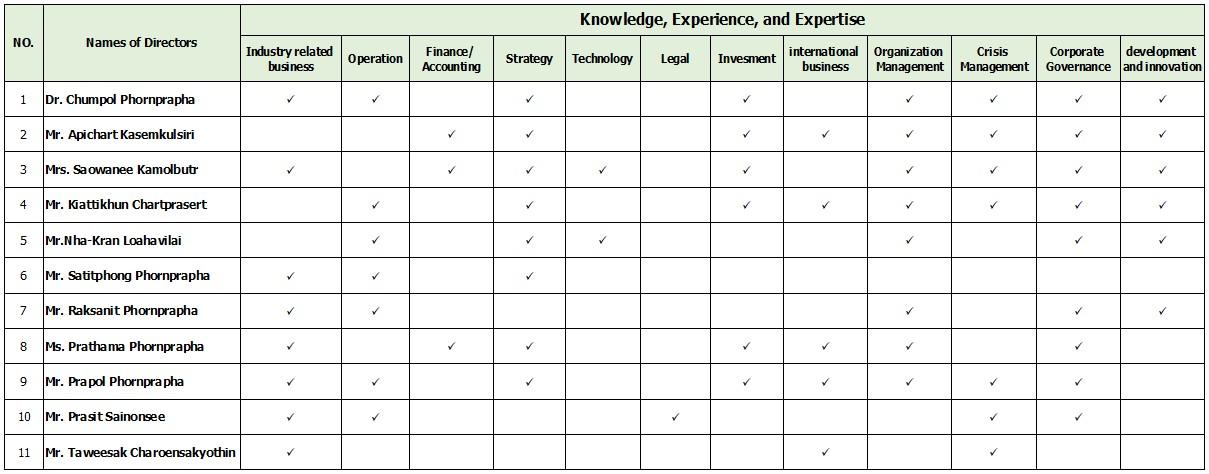
2. The Company reviewed directors’ qualifications based on the Board Skill Matrix including the board’s diversity such as gender, age, knowledge and experience of directors to be suitable for business strategies.
Board Skill Matrix
Reviewed the CG Policy or Board Charter in the Past Year
Yes
Material Changes or Developments in the Past Year
Yes
Policy Review — Description
The Company reviewed its policies, practices, and corporate governance systems in the Board of Directors Meeting No. 4/2025, held on 12 November 2025, and updated the Company’s code of conduct and charter to enhance and support corporate governance of the Company and its subsidiaries
Implements the CG Code for Listed Companies
No
CG Code — Description
In 2025, the Company abided by the principles of good corporate governance except for the following:
1. Appointment of an independent director as chairman of the board.
2. Appointment of the Corporate Governance Committee, which has members of all committees.