

Sustainability · 2025
In this section52 topics
- Sustainability Policy3 items
- Sustainability Goals & UN SDGs3 items
- Policy Review3 items
- Impacts on Stakeholders — Overview1 item
- Business Value Chain2 items
- Stakeholder Analysis2 items
- Environmental Sustainability — Overview1 item
- Environmental Policy & Guidelines4 items
- Environmental Policy Review3 items
- Energy — Plan & Guidelines5 items
- Energy — Electricity Consumption1 item
- Energy — Fuel Consumption1 item
- Energy — Targets2 items
- Energy — Performance & Outcomes2 items
- Water — Plan & Guidelines2 items
- Water — Withdrawal, Discharge & Consumption1 item
- Water — Targets2 items
- Water — Performance & Outcomes2 items
- Waste — Plan & Guidelines2 items
- Waste — Generation, Disposal & Recycling1 item
- Waste — Targets3 items
- Waste — Performance & Outcomes2 items
- GHG — Plan & Guidelines2 items
- GHG — Emissions1 item
- GHG — Emissions Verification1 item
- GHG — Principles & Standards1 item
- GHG — Targets2 items
- GHG Targets — Other Targets2 items
- GHG — Performance & Outcomes2 items
- Environmental Legal Incidents1 item
- Other Environmental Management2 items
- Social Sustainability — Overview1 item
- Social Policy & Guidelines3 items
- Social Policy Review3 items
- Human Rights Due Diligence2 items
- Employees — Plan & Guidelines3 items
- Employees — Workforce1 item
- Employees — Remuneration & Provident Fund1 item
- Employees — Training & Development1 item
- Employees — Occupational Health & Safety1 item
- Employees — Labour Relations1 item
- Employees — Employee Representation1 item
- Employees — Targets2 items
- Employees — Performance & Outcomes2 items
- Customers — Plan & Guidelines3 items
- Customers — Satisfaction Results1 item
- Customers — Targets2 items
- Customers — Performance & Outcomes2 items
- Community & Social — Plan & Guidelines3 items
- Community & Social — Targets2 items
- Community & Social — Performance & Outcomes2 items
- Law Violation Incidents1 item
Sustainability Policy
Introduction
With a commitment to conduct business with transparency based on good corporate governance, the Company has an ultimate goal; which is the sustainability of the organization which creates shared values in the economy, society, and environment in the Company's business chain. To enhance sustainable development, the organization's sustainability development policy has been formulated as business guidelines of the Company Group as follows:
Has a Sustainability Policy
Yes
Policy Description
Sustainability Strategy
1. Establish a sustainable development strategy for the organization that covers good corporate governance, corporate risk management, and new risks that may arise in the future.
2. Determine processes to assess and respond to risk issues affecting the Company’s sustainability in terms of economy, society, environment, and good governance, such issues are considered critical in business planning, business decisions, and operational processes so as to maintain the stability and sustainability of the organization.
Sustainability Goals & UN SDGs
Introduction
The Company remains committed to being a leader in the motorcycle hire-purchase business in Thailand and neighboring countries with a mission to take good care of all groups of stakeholders in a balanced manner. The Company integrates the mission with the strategy and direction of the organization's sustainable business operation to show social and environmental responsibility.
Has Sustainability Goals
Yes
Goals Description
Good governance
1. Uphold the principles of integrity and transparency in business operations and performance and comply with the laws, rules, regulations, methods, and standards set by regulatory agencies.
2. Uphold and follow the guidelines and practices set forth in the Company's Code of Conduct including relevant policies, regulations, and announcements of the Company in relation to good corporate governance, risk management, business continuity management, policies on shareholders, employees, society and environment, anti-corruption, safety, occupational health and working environment, usage of network systems and computers, etc.
Economy
1. Seek ways to develop and improve operational efficiency in all activities continuously by determining goals, methods of measurement, monitoring, and assessment of the sustainability of the activities.
2. Develop and promote corporate innovation and new technology as a business strategy to create added value and long-term corporate growth as well as mutual benefits for society and the environment.
3. Promote and support allies, partners, and stakeholders throughout the business chain to operate in accordance with the guidelines of sustainable development.
Safety
1. Stimulate awareness and cultivate a culture of safety, environmental protection, and social responsibility continuously and regularly.
2. Set a “Zero" accident at work by developing, improving, and upgrading safety standards beyond regulatory requirements. Besides any operations without proper and adequate safety control measures and training are prohibited.
Human Rights
1. To be an organization that accepts and respects diversity and treats all employees and workers without discrimination by giving equal opportunity and assigning enough tasks according to their abilities with reasonable returns and prohibits the employment of workers under the age of 18 and illegal workers.
2. Take care and protect the safety of all employees and the Company's assets without affecting the rights and safety of others. This includes protecting personal rights as well as confidentiality, disclosure, and use of personal information.
3. Respect the rights of all employees, workers, and partners of the Company, honor and treat them all with equality and human dignity.
Human Rights and Labor Justice
The Company has designated a policy on non-violation of human rights, stating that employees are equally treated and given opportunities to develop themselves for professional advancement to ensure sufficient capabilities to perform their duties. Executives and employees are obligated to comply with human rights principles which are considered as part of their duties and there must be no violation of human rights. The Company prohibits the use of child labor and human trafficking and discourages engaging in or accepting any form of bribery or corruption. In 2025, the Company prepared a Human Rights Risk Assessment Report and disclosed the results of the assessment in the 2025 Form 56-1 One Report.
During the year 2025, the Company has not received any complaints relating to human rights violations from employees, suppliers, and other stakeholders which builds the confidence that the Company’s operation has not caused or possibly caused adverse impact to communities and society.
Personal Data Security
The Company respects and recognizes the importance of personal data protection according to the Personal Data Protection Act B.E. 2562 (2019) to gain trust and confidence from customers that the Company will collect, use, and disclose their personal data according to the purposes set out in the personal data protection policy. The Company has established a policy and guidelines for the protection of personal data for customers to be informed about collection, storage, usage, disclosure of personal data, rights of personal data owners, and the Company’s practices and announced the personal data protection policy and guidelines for information.
Goals | Current actions | Strategies to achieve goals |
|
employees on the Personal Data Protection Act B.E. 2562 (2019)
appointed to perform the duties of Personal Data Protection Officers, (Data Protection Officer : DPO)
policies and practices regarding personal data protection on a regular basis on a regular basis |
|
Society and Community
1. Take care and treat employees fairly and equitably without discrimination against race, color, religion, sex, age, sexual orientation, or disability to provide a good quality of life for all employees.
2. Strengthen and promote participation of communities and related stakeholders with openness to opinions, transparent and constructive consultations, equal treatment to each other, and respect for differences as well as supporting the improvement of the quality of life and the strength of the community
3. To carry out work on social development and public benefits by cooperating with network partners, including communities, government agencies, and the public sector to improve the well-being and environment of the community in society.
Human Resources Development
1. Employee compensation and benefits
The Company provides fair remunerations appropriate to the responsibilities and work performance of each employee. Various benefits are also provided to employees in addition to those governed by laws such as performance bonuses, employee rewards programs, provident funds, and annual physical checkup arrangements.
2. Competency Development
The Company is confident that personnel development by various methods is important to encourage employees with potential and performance to maximize their knowledge and skills which will help strengthen the competitiveness of the organization. The program is divided into training and development for both new staff and the existing ones.
2.1 Training and development for the new staff
Orientation for new staff; a training that provides knowledge and understanding to new personnel in order to provide a basic understanding of the organization and enable them to adjust and create a harmonized working environment.
2.2 Training and development for the existing staff
The Company has established a plan for personnel development to encourage employees to meet the operational goals as well as to prepare them for the jobs (rotation) and promotion. These include the framework of development as follows;
Development according to training by the position and years of service so the employees will be equipped to handle and manage each position according to the Company’s expectations.
In-house seminars, the experienced staff from various aspects will be assigned to be the trainers.
Sending the staff to attend seminars outside the Company.
3. Health Care Project
The Company recognizes the importance of its employees’ health and thus places great emphasis on promoting good health and quality of life by setting up the following programs continuously;
Annual medical check-ups with a check-up program that is suitable for each staff’s age and job characteristics.
Against Drugs program within the organization.
Medical assistance benefits to relieve employee’s financial burden related to medical treatment fees for both cases of in-patients and out-patients.
Assistance to employees in cases of work-related accidents or injuries beyond what is covered by social security, including assistance with employee medical expenses, third-party medical expenses, third-party property damage, court fees, and in cases of employee or third-party death
Various employee wellness programs, the exercise facilities are available to relieve employees from work and join the activities together to create a harmonious workplace, strengthen teamwork, and provide learning and development opportunities to the employees.
4. Safety workplace policy
The company places great emphasis on safety in the workplace, and fire drills and safety training have been continuously organized. The Company has set up a working environment and facilities with sufficient safety equipment to ensure a safe and healthy working environment, including providing Safety Riding training courses as well as encouraging helmet-wearing.
Conduct safe driving training and promote helmet use.
Conduct first aid training, focusing on helping those around you.
5. Employee’s welfare and quality of life development program
The Company values employees’ quality of life, thus providing various benefits to support the welfare and development of employees together with the sustainable growth of the Company.
Employee welfare fund,established in 1990 aims to alleviate hardship and damage to physical well-being and property in the event of accidents (both during and outside working hours).
Funeral Assistance Fund, established in 1992, provides mutual assistance among members and their families in the event of death (legally married spouse, parents, and children aged 3 years and older).
Group accident insuranceis provided to compensate in the event of death, loss of sight or limb, or disability of an employee due to an accident within 24 hours. The sum insured is in accordance with each employee’s position,The insured amount depends on the job position and covers all positions.
The scholarship for employees’ children was established in 1992 and continually granted each year to the eligible dependent children of employees who are awarded for school years from kindergartenupto university level. In 2025, the Company provided 515 scholarships or Baht 662,400 for children of employees. Hence, Thitikorn PLC has continued this program for educational support for the 34th year while realizing the important role of education in society and national development. This program is meant to enhance the quality of human resources for our society and to build morale for employees and their families.
Housing loan granted by Government Housing Bank in the amount of 100% of home appraisal value or purchase price with a low interest rate.
Welfare Loan Program with the Islamic Bank of Thailand: Available to employees of Thitikorn Public Company Limited and its affiliates. This includes housing loans and multipurpose loans, both secured and unsecured.
Other welfare benefits including wedding ceremonies, and funeral ceremonies for employees or employee’simmediate family members, and congratulatory gifts for employees upon the birth of their first child.
Environment and Response to Climate Change
1. Manage waste from the service process systematically to ensure that every process of business operationsis based on proper caring and treatment to reduce the impacts on the environment both short term and long term.
2. Use various resources for maximum efficiency.
3. Think and seek ways and methods to minimize the use of resources and energy as well as decrease waste emissions and greenhouse gases to ensure that the impacts on the environment, community, and society are prevented, controlled, and reduced to a minimum.
Collaboration with all sectors to promote sustainable development
Raise awareness for everyone in the organization to collaborate, both in terms of laws and regulations, with all sectors including governments, businesses, communities, and civil society to promote sustainable development.
Policy Review
Policy Reviewed This Year
Yes
Policy Changed This Year
Yes
Review Details
The Company has revised its sustainability policies and goals to align with the new regulatory framework of the Bank of Thailand, aiming to strike a balance between consumer protection, expanding access to financial services, and ensuring the long-term sustainability of the financial system. In addition, the Company has implemented social initiatives such as supporting persons with disabilities and fostering human capital development, with the objective of positioning the organization as a role model for sustainability in the Thai capital market.
Impacts on Stakeholders — Overview
Introduction
The Company’s realization of the importance of stakeholder management throughout the business value chain. Stakeholders cover the affected people or people that may affect the operations of the Company in the past, at present, and in the future. Stakeholder management is operated along with effective business value chain management to ensure that stakeholders are treated in a balanced manner according to the organization's missions. The Company’s stakeholders are categorized into 8 main groups, namely shareholders and Investors, customers, employees, suppliers, competitors, creditors, society, communities and environment, and government sectors/government agencies/related organizations. Stakeholder analysis aims to realize stakeholders' perspectives and expectations on the business operation, including helping to determine appropriate guidelines for engaging with stakeholders regularly.
Business Value Chain
Introduction
The value chain of the motorcycle leasing business encompasses everything from motorcycle procurement and customer qualification and credit checks to contract signing, delivery, payment tracking, and bad debt management. Primary activities include logistics, operations, marketing and sales, and after-sales service, while supporting secondary activities such as organizational structure, human resource management, technology development, and procurement are all interconnected to create value for customers, shareholders, partners, and society as a whole.
Value Chain Description
Value Chain Characteristics for Motorcycle Hire-Purchase Business
1. Inbound Logistics
Refers to processes related to sourcing and receiving motorcycles for hire-purchase, including customer information required for assessment.
Key Activities:
Selecting reliable dealers/motorcycle shops
Negotiating prices, discounts, and delivery terms
Obtaining preliminary customer information from dealers (KYC, income, guarantor)
Organizing purchase order and vehicle delivery documentation
Assessing vehicle costs and operating expenses that affect interest rate determination
2. Operations
The core of the hire-purchase business, focusing on credit evaluation and contract preparation.
Key Activities:
Collaborating with dealers to offer hire-purchase programs
Verifying customer documents (KYC, KYB for businesses)
Conducting credit assessment and risk scoring
Performing field checks at home or workplace
Approving credit applications
Preparing hire-purchase contracts and opening debtor accounts
Submitting information to the credit bureau
3. Outbound Logistics
In this business, it refers to delivering motorcycles to customers and activating services.
Key Activities:
Sending contracts and approval results back to dealers
Dealers delivering motorcycles to customers
Transferring registration or preparing legal vehicle documents
Providing information on initial payment and installment guidelines
Integrating data systems between company–dealer–customer
4. Marketing & Sales
Activities that help customers access hire-purchase services.
Key Activities:
Building dealer relationships (Dealer Relationship Management)
Running joint promotions with motorcycle shops (low down payment, long-term installments, etc.)
Deploying on-site sales teams at dealerships
Offering hire-purchase programs tailored to customer segments
Building brand credibility and communication
Providing installment and interest rate information via online channels
5. After-Sales Service
Directly impacts debt quality and company sustainability.
Key Activities:
Sending installment payment reminders (SMS / Call Center)
Offering multiple payment channels (QR, Mobile Banking, counter services)
Providing customer service support
Debt collection according to risk levels
Managing non-performing loans (Recovery / Repossession)
Assisting with vehicle usage issues or ownership transfer upon completion of payments
Offering insurance and claims services in collaboration with insurance companies
Support Activities for Hire-Purchase Business
1. Firm Infrastructure
Accounting and financial reporting systems
Risk management systems
Credit and collection policies
Compliance and legal frameworks
Reporting to regulatory authorities
2. Human Resource Management
Training sales teams, credit approval teams, and debt collection teams
Performance evaluation and compensation aligned with portfolio quality
Retaining skilled personnel specialized in hire-purchase credit
3. Technology Development
Credit scoring and automated loan approval systems
Installment tracking and collection systems
Mobile applications for customers
Fraud detection systems
4. Procurement
Procuring office systems and equipment
Procuring insurance services or value-added services
Organizing joint sales promotion events with dealers
Stakeholder Analysis
Introduction
In 2025, the Company has determined the importance of each group of stakeholders and their impact on the growth and sustainability of business operations as shown in the table below, focusing on the priority and the method of the Company in responding to each group of stakeholders effectively. This enables the Company to achieve its business objectives under the framework of responsibility to stakeholders in terms of economy, society, and environment according to good corporate governance guidelines.
Stakeholder Analysis
| Stakeholder Type | Stakeholders | Stakeholder Expectations | Response to Expectations | Communication Activities |
|---|---|---|---|---|
| External stakeholders | 2913 · Description: Shareholders · 2936 · Other name: Investors · Description: Others | • Income, share price, and dividend that give worthwhile returns
• Treating shareholders
equitably
• Fair business practices and transparent
disclosure of information
• Guidelines for good
corporate governance
• Reputation and credibility
of the Company
• Business sustainable growth
| • Determine strategies and goals
that are in line with the growing
trend of business.
• Organize the annual
shareholders' meeting to be a
a platform for asking questions
and expressing their opinions.
• Provide opportunities for the
shareholders to express
comments on various issues
through the Company’s
channels.
• Oversee operations to ensure
compliance with good
corporate governance.
• Perform operations strictly
under relevant laws and
regulations.
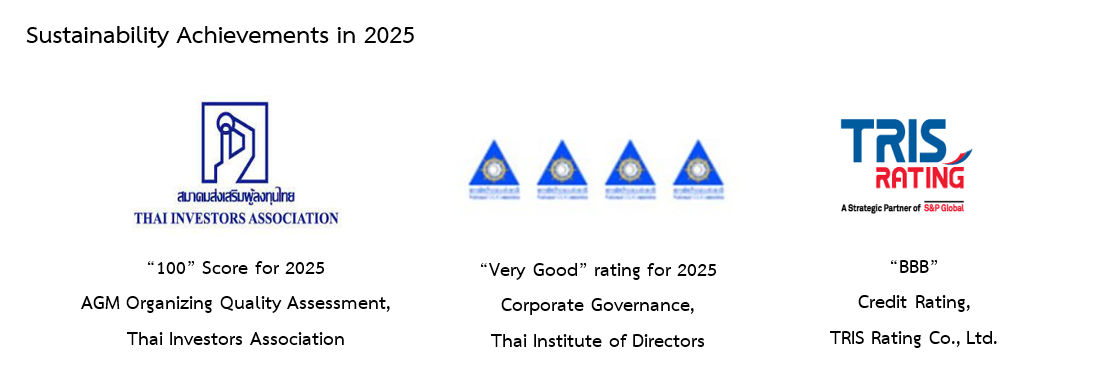
• Received a full score of 100 (for the 18th consecutive year) from an assessment on the quality of the Annual General Meeting (AGM) from the Thai Investors Association (TIA)
| 2940 · Description: Social Event · 2941 · Description: Online Communication · 2944 · Description: Annual General Meeting (AGM) · 2945 · Description: Complaint Reception · 2949 · Other name: Annual report · Description: Others · 2949 · Other name: Present the business performance on the Opportunity Day · Description: Others |
| External stakeholders | 2923 · Description: Customers | • Deliver quality and speed of service.
• Employees must be honest.
• Protect customer data.
• Compliance with the Terms and conditions of the contract
• Employees have knowledge and ability to appropriately provide services and useful suggestions
| • Be able to provide clear, accurate, and transparent information.
• Review the operating process and service on a regular basis to ensure that the current the system responds to customer needs.
• Develop IT capabilities to meet the needs of customers.
• Comply with the Code of Conduct on protecting the confidentiality of all stakeholders.
• Implement measures to protect personal data privacy for customers
• Offer channels for 2-way communication.
| 2941 · Description: Online Communication · 2949 · Other name: Application TK Plus and Line @TK Plus · Description: Others |
| Internal stakeholders | 2921 · Description: Employees | • Define roles, duties and responsibility of each position.
• Receive fair and Persuasive compensation and welfare close to those in the same business.
• Develop employee Potential and promote career advancement according to the level of positions and duties.
• Have safety at work and good working environment. | • Organize Staff Meetings according to job titles at least once a year to inform progress and exchange ideas.
• Organize both HR and CSR activities throughout the year for employee engagement.
• Organize regular training to increase employee potential.
• Use principles of performance appraisal according to Key. Performance Indicators (KPIs)
• Treat employees fairly.
• Provide proper employee welfare and benefits such as provident fund, social security fund, health benefits, annual medical check-up
• Select and hire employees according to human rights principles focusing on equality, diversity, non-exclusion and non-discrimination against race or gender as well as focusing on abilities that are suitable for business models.
• Provide channels for 2-way communication., Employees may propose the welfare benefitsthey desire through HR, which will then be submitted to management for consideration
• 0% of labor problems or complaints.
| 2940 · Description: Social Event · 2941 · Description: Online Communication · 2948 · Description: Training / Seminar · 2949 · Other name: Use KPIs as a tool for performance appraisal and measurement. · Description: Others |
| External stakeholders | 2899 · Description: Suppliers | • Have a clear business objectives.
• Comply with terms and conditions according to contractual agreements.
• Have a clear system and workflow.
• Have effective teamwork with fair and equal practices.
• Protect data privacy.
• Provide communication channels for expressing ideas and comments.
• Uphold Anti-corruption Policy.
| • Build a good relationship to create confidence and trust in doing business with each other.
• Protect confidential information and keep a record according to applicable rules, regulations, and business needs.
• Notify of the Code of Conduct and practices including anti-corruption.
• Organizing training sessions in collaboration with business partners to promote and enhance their capabilities.
| 2941 · Description: Online Communication · 2945 · Description: Complaint Reception · 2949 · Other name: Meetings and follow-up on the continuity of the project. · Description: Others |
| External stakeholders | 2898 · Description: Competitors | • Conduct business with honesty and compliance with relevant law. | • Adhere to fair competition and business operation policies.
• Follow the organization's best practices and good governance in business operations.
| 2941 · Description: Online Communication |
| External stakeholders | 2894 · Description: Creditor | • Be trustworthy and conform to terms and conditions of
the contract.
| • Be trustworthy and strictly conform to terms and conditions mutually agreed upon by creditors.
• Build relationships with creditors to create confidence and trust with each other.
| 2949 · Other name: Define and communicate policies as well as clear procedures and regulations in doing business. · Description: Others |
| External stakeholders | 2902 · Description: Community · 2928 · Description: Society · 2936 · Other name: environment · Description: Others | • Build engagement of all stakeholders to give them chances to participate in social and environmental activities. | • Adhere to the policy supporting participation in giving back to society and community as well as developing the environment regularly.
• Cultivate awareness of employees in social responsibility, community, and environment.
• Encourage sharing of knowledge on giving back to society through training and practice from various activities.
• Participate in creating innovations for the Company’s sustainability.
• Utilize resources properly.
• Open to suggestions from communities around the premises to find solutions to settle complaints together
| 2940 · Description: Social Event · 2949 · Other name: Disseminate CSR projects through internal and external communication. · Description: Others |
| External stakeholders | 2931 · Description: Government agencies and Regulators | • Conduct business in compliance with the law.
• Define and conform to corporate governance policy.
• Communicate to employees about compliance with the law.
• Cooperate and support business operations.
| • Strictly adhere to the law.
• Publish all policies, regulations including ethical and operational guidelines for employees to acknowledge and comply.
• Follow compliance with rules and regulations regularly.
| 2942 · Description: Internal Meeting · 2948 · Description: Training / Seminar |
Environmental Sustainability — Overview
Operating Results — Introduction
Summary of the operating performance in the environment | ||
Type | Operating performance | |
2024 | 2025 | |
Material Paper consumption (kg.) | 4,922 | 4,287 |
Energy Energy Benzene fuel consumption (Liter) Diesel fuel consumption (Liter) Electricity consumption (kilowatt-hour (kWh) | 1,361 183,531 1,245,401 | 2,137 136,947 763,765 |
Emission of greenhouse gas Scope 1: tCO2e Scope 2: tCO2e Scope 3: tCO2e | 506.02 622.58 445.47 | 380.09 381.81 512.51 |
Water Water consumption (m3) | 14,761 | 9,626 |
Environmental Policy & Guidelines
Introduction
From the sustainability policy on environmental dimensions (Environment Policy), the Company is committed to protecting the environment, occupational health, and safety in the workplace of personnel, property, and work processes. This includes preventing pollution and improving the workplace’s environment by focusing respectively on the Re-Use to manage the use of nonrenewable resources to the maximum benefit, implementing resource management, cleaning, reducing supplies, and sorting out materials that are not beneficial to the workplace and environment.
The Company conducts business in strict compliance with laws and regulations related to the environment and raises awareness for employees to utilize resources efficiently by conserving nature and taking into consideration environmental impacts across the supply chain as well as considering investments with environmentally responsible business partners.
The Company recognizes the importance of environmental preservation throughout the supply chain. It includes the selection of products that do not destroy nature and are environmentally friendly, strict compliance with the spirit of laws and regulations issued by regulators, reduction of scrap materials in the work process, and determination of standards for the use of air conditioners, lights, lighting, and computers based on the consideration of maximum benefits. This aims to save costs and create awareness of sustainable energy savings for public benefit.
Has an Environmental Policy
Yes
Policy Description
Electric power management
Electricity is a source of energy that is considered an important factor for an organization’s business operations. Electricity is required at almost every step of the operating process. The organization's growth and increase of branches cause the amount of electricity consumption to increase with more cost and more pollution. Therefore, the Company has set measures to manage electricity to be worthwhile and most suitable as follows:
Management approaches
The time is set for using the air conditioner. For the head office, the time is set to turn on-off and there is a monitor to turn on the air conditioner as appropriate taking care of the air conditioner annually.
There is a limit to reimbursing the electricity bill of the branch that is suitable for the operation and the amount of usage.
Regular maintenance of the air conditioner is required
Oil and fuel management
Currently, the operation within the Company is inevitably still powered by oil. However, we still consider the impact of greenhouse gases that cause global warming and climate change. The following oil management measures have been established.
Management approaches
To set proper criteria for monthly fuel fee withdrawal for employees of each position.
To control the company's vehicle usage as necessary.
Water resource management and water quality
Water is one of the resources that is fundamental to life. In current business operations, there is a problem of flooding. Some areas are also prone to drought which affects the ability to develop the economy and improve the quality of life of people in society. In addition, the increase in the population has resulted in the demand for rising water. As a result, Thailand has continuously faced the water crisis problem. The Company therefore realizes the importance of water conservation through water conservation campaigns and public relations for all personnel to jointly conserve water resources with the following measures.
Management approaches
Check the equipment in the use of water supply regularly. If detected, hurry to complete the repair as soon as possible.
Raise awareness and campaign to educate employees on environmental conservation so they know how to use resources for the most benefit.
Effluent and Waste Management
The wastewater generated from operations (Head office) is mostly from restrooms, toilets, and sinks. We have a method for managing wastewater by Aerated wastewater treatment system the quality of the treated water meets the legal requirements before discharging to other organizations.
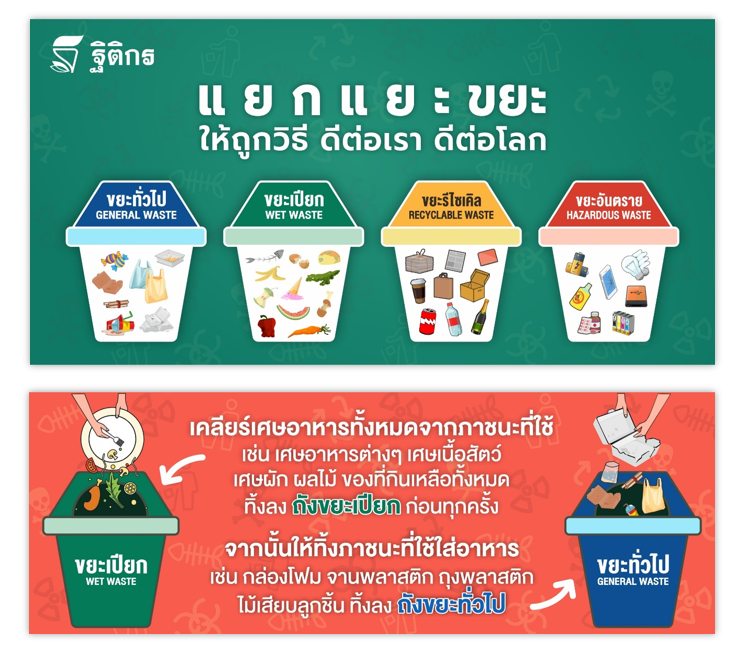
The waste is classified according to the color of the bin as general waste, infectious waste, hazardous waste, electronic waste (toner cartridges, damaged electrical equipment), and waste that can be recycled. The district will be responsible for handling waste properly.
The Company has set a goal to foster a green culture through waste separation, aiming for Zero Waste to Landfill. In 2025, the Company successfully achieved this target.
The Company has set a target to reduce paper usage by implementing a policy of reusing single-sided paper in order to minimize waste and reduce environmental impact. In 2025, the company reduced paper usage by 12.9% compared to the previous year, achieving this target.
In 2025, the Company did not release wastewater that exceeded the standards and laws. In addition, the Company did not pay any fines or environmental penalties.
Greenhouse gas management and climate change
As the Motorcycle hire-purchase service provider, it is inevitable for the Company to operate the process using various fuels, whether it is electrical energy or the use of petrol from cars used in the Company’s activities. This is one of the causes of greenhouse gas emissions such as dust, CO, and CO2, into the atmosphere. The Company therefore places importance on participating in the reduction of greenhouse gas emissions resulting from operational processes such as reducing energy consumption, reducing fuel consumption from various cars, etc.
The main reason for the current climate change problem is the implementation of activities of all sectors whether using fuel deforestation, use of various energy, etc. Climate change is caused by, for example, drought, flood, rising sea levels, etc., which greatly affects the way of life and business today.
Paper Usage Management
The company has changed the way it manages documents by reducing paperwork and collecting documents in electronic file formats. Since the company has a policy for controlling and reducing paper usage to subside indirect impacts on the environment, it has taken the following measures:
Management approaches
Reduce | Reuse | Recycle |
1. Store documents in an electronic format. 2. Organize a meeting electronically with a PDF file document instead of a paper copy. 3. Reduce hard copies of training materials by distributing electronic files. 4. Store documents in an electronic format and use share drive. 5. Develop an electronic receipt system (E-Receipt) that abides by the law. | Reuse the one-side used paper. | Provide 4 types of garbage bins for waste segregation, consisting of wet waste, general waste, recyclable waste, and hazardous waste. Recycled waste can generate value from selling used paper, carton boxes, and clear / plastic bottles. |
Environmental Guidelines
| Guideline | Other — Please Specify |
|---|---|
| Electricity Management | |
| Fuel Management | |
| Water Management | |
| Waste Management | |
| Greenhouse Gas and Climate Change Management | |
| Others | Paper Usage Management |
Environmental Policy Review
Policy Reviewed This Year
Yes
Review Details
In 2025, the Company set environmental objectives aimed at reducing operational impacts through energy efficiency, greenhouse gas mitigation, sustainable resource and waste management, and cultivating a green organizational culture with active community participation, thereby contributing to the transition toward a low-carbon economy and generating long-term shared value for society.
Policies & Guidelines Changed
| Change | Other — Please Specify |
|---|---|
| Electricity Management | |
| Fuel Management | |
| Water Management | |
| Waste Management | |
| Greenhouse Gas and Climate Change Management | |
| Other | Managing paper usage. |
Energy — Plan & Guidelines
Introduction
The Company is committed to controlling the use of resources and energy efficiently coupled with giving knowledge and creating awareness among employees including those involved in the role and responsibility of preventing environmental impact.
Has an Energy Management Plan
Yes
Plan Description
Replacement of electronic appliances used in the Company and its branches with energy-saving models.
Post water conservation signs and posters in the office
Encouraging walk up the stairs for one floor instead of taking the elevator to save energy
Encouraging turn off computer when not in use
Turning off the lights during lunch break or in working areas where not in use by employees and Executives for a long period
The “Reduce Plastic Usage” campaign was organized to create involvement of as many employees of the Company and its subsidiaries as possible. The SPI declaration has been signed, stating to reduce plastic waste, use cloth bags instead of plastic bags, and replace the use of foam or single-use plastic food packaging with reusable food containers and utensils. The Company also plans to promote these activities to the employees’ families in the future.
“Business travel” The Company has reduced unnecessary business trips by using information technology to replace travel for meetings and seminars abroad which resulted in a decrease in traveling abroad by 100% in 2021. This is due to the Company’s commitment to reducing greenhouse gas production and the epidemic situation of COVID-19.
Plan Document Link
https://tkw03.thespi.com/tkweb/tk/ir/corporate_governance.html
Page Number in Report
1
Energy — Electricity Consumption
Electricity Consumption
| Metric | Current Year | Previous Year | Two Years Ago |
|---|---|---|---|
| Total electricity consumption within the organization (Kilowatt-Hours) | 763,765 | 1,245,401.41 | 1,352,632.25 |
| Electricity purchased for consumption from non-renewable energy sources (Kilowatt-Hours) | 763,765 | 1,245,401.41 | 1,352,632.25 |
| Electricity purchased or generated for consumption from renewable energy sources (Kilowatt-Hours) | 0 | 0 | 0 |
Energy — Fuel Consumption
Fuel Consumption
| Metric | Current Year | Previous Year | Two Years Ago |
|---|---|---|---|
| Jet fuel (Litres) | 0 | 0 | 0 |
| Diesel (Litres) | 136,947 | 183,531 | 242,795 |
| Gasoline (Litres) | 2,137 | 1,361 | 389 |
| Fuel oil (Litres) | 0 | 0 | 0 |
| Crude oil (Barrels) | 0 | 0 | 0 |
| Natural gas (Standard cubic feet) | 0 | 0 | 0 |
| LPG (Kilograms) | 0 | 0 | 0 |
| Steam (Metric tonnes) | 0 | 0 | 0 |
| Coal (Metric tonnes) | 0 | 0 | 0 |
Energy — Targets
Has Set Targets
Yes
Targets
| Target | Base Year | Base Year Value | Target Year | Target Change (%) | Unit |
|---|---|---|---|---|---|
| Reduction of electricity purchased and fuel consumption | 2,024 | 1,430,294 | 2,025 | 5 | Kilowatt-hour |
Energy — Performance & Outcomes
Has Performance Results
Yes
Performance Description
The Company has set a target to reduce electricity and fuel consumption by at least 5% from the 2024 baseline. In 2025, the Company’s electricity and fuel consumption amounted to 902,849 kWh, representing a 37.0% reduction, in line with the target.
Water — Plan & Guidelines
Has a Water Management Plan
Yes
Plan Description
"Using water" The Company launched a campaign to raise awareness among employees in the cost-effective use of water resources, causing an effective decrease in water consumption in 2025, for example, not opening the water tap while cleaning dishes and using equipment designed for water saving.
Water — Withdrawal, Discharge & Consumption
Water Withdrawal, Discharge & Consumption
| Metric | Current Year | Previous Year | Two Years Ago |
|---|---|---|---|
| Total water withdrawal (Cubic meters) | 9,626 | 14,761 | 19,334 |
| Total water withdrawal by third-party water (Cubic meters) | 9,626 | 14,761 | 19,334 |
| Total water withdrawal by surface water (Cubic meters) | 0 | 0 | 0 |
| Total water withdrawal by groundwater (Cubic meters) | 0 | 0 | 0 |
| Total water withdrawal by seawater (Cubic meters) | 0 | 0 | 0 |
| Total water withdrawal by produced water (Cubic meters) | 0 | 0 | 0 |
| Percentage of wastewater treated before discharge (%) | 0 | 0 | 0 |
| Total water discharge (Cubic meters) | 0 | 0 | 9,799 |
| Total water discharge to third-party water (Cubic meters) | 0 | 0 | 9,799 |
| Total water discharge to surface water (Cubic meters) | 0 | 0 | 0 |
| Total water discharge to groundwater (Cubic meters) | 0 | 0 | 0 |
| Total water discharge to seawater (Cubic meters) | 0 | 0 | 0 |
| Total water consumption (Cubic meters) | 9,626 | 14,761 | 9,535 |
| Recycled water (Cubic meters) | 0 | 0 | 0 |
Water — Targets
Has Set Targets
Yes
Targets
| Target | Base Year | Base Year Value | Target Year | Target Change (%) | Unit |
|---|---|---|---|---|---|
| Reduction of water withdrawal | 2,024 | 14,761 | 2,025 | 5 | Cubic meters |
Water — Performance & Outcomes
Has Performance Results
Yes
Performance Description
The Company set a target to reduce water consumption by at least 5% from the 2024 baseline. In 2025, the Company’s water consumption decreased by 34.8%, achieving the target.
Waste — Plan & Guidelines
Has a Waste Management Plan
Yes
Plan Description
“Waste Management” In 2025, the Company has seriously undertaken activities related to waste management by initiating and creating employee engagement to save the environment by separating waste with a desire to enhance employee awareness and make behavioral changes starting from their workplace and passing to their own homes. Such various activities resulted in a significant change in the Company, for example, employees were aware of environmental problems, recognized the importance of sharing social responsibility, and took part in joining the Company’s activities such as separating plastic bottles, paper, and general waste, separating food waste from containers, and clean plastic food packaging.
Waste — Generation, Disposal & Recycling
Waste Generation, Disposal & Recycling
| Metric | Current Year | Previous Year | Two Years Ago |
|---|---|---|---|
| Total waste generated (Kilograms) | 45,669 | 35,258 | 30,449 |
| Non-hazardous waste (Kilograms) | 45,619 | 35,123 | 30,336 |
| Non-hazardous waste - Landfilling (Kilograms) | 0 | 0 | 0 |
| Non-hazardous waste - Incineration (with energy recovery) (Kilograms) | 0 | 0 | 0 |
| Non-hazardous waste - Incineration (without energy recovery) (Kilograms) | 0 | 0 | 0 |
| Non-hazardous waste - Other disposal operations (Kilograms) | 45,619 | 35,123 | 30,336 |
| Hazardous waste (Kilograms) | 50 | 135 | 113 |
| Hazardous waste - Landfilling (Kilograms) | 0 | 0 | 0 |
| Hazardous waste - Incineration (with energy recovery) (Kilograms) | 0 | 0 | 0 |
| Hazardous waste - Incineration (without energy recovery) (Kilograms) | 0 | 0 | 0 |
| Hazardous waste - Other disposal operations (Kilograms) | 50 | 135 | 113 |
| Total reused/recycled waste (Kilograms) | 8,088 | 9,360 | 10,791 |
| Reused/Recycled non-hazardous waste (Kilograms) | 8,038 | 9,226 | 10,709 |
| Reused non-hazardous waste (Kilograms) | 4,019 | 4,613 | 5,354.5 |
| Recycled non-hazardous waste (Kilograms) | 4,019 | 4,613 | 5,354.5 |
| Reused/Recycled hazardous waste (Kilograms) | 50 | 134 | 82 |
| Reused hazardous waste (Kilograms) | 25 | 67 | 41 |
| Recycled hazardous waste (Kilograms) | 25 | 67 | 41 |
Waste — Targets
Introduction
The Company has set a goal to foster a green culture through waste separation, aiming for Zero Waste to Landfill. In 2025, the Company successfully achieved this target.
Has Set Targets
Yes
Targets
| Waste Type | Disposal Approach | Target | Base Year | Base Year Value | Target Year | Target Change (%) | Unit |
|---|---|---|---|---|---|---|---|
| Non-hazardous waste | 2758 · Description: Reuse | Reduce waste volume | 2,024 | 35,258 | 2,025 | 5 | Kilograms |
Waste — Performance & Outcomes
Has Performance Results
Yes
Performance Description
The Company has set a target to reduce waste and residues by at least 5% from the 2024 baseline. In 2025, however, the Company’s waste and residues increased by 29.5%, which did not meet the target.
In 2025, the Company did not release waste water that exceeded the standards and laws. In addition, the Company did not pay any fines or environmental penalties, The company is accepting donations of stockings and paper cups for use in manufacturing prosthetic limbs.
GHG — Plan & Guidelines
Has a GHG Management Plan
Yes
Plan Description
The Company as a Motorcycle hire-purchase service provider is inevitable that in the process of operation, various fuels are used whether electricity, use of oil from cars used in the Company’s activities which is one of the causes of greenhouse gas emissions such as particulate matter, CO, CO2 into the atmosphere. Operational processes are such as reducing energy consumption, reducing fuel consumption from cars, etc.
In 2025, the Company conducted the organization’s carbon footprint by measuring greenhouse gas emissions in 3 scopes.
GHG — Emissions
GHG Emissions
| Metric | Current Year | Previous Year | Two Years Ago |
|---|---|---|---|
| Total GHG emissions (Metric tonnes of carbon dioxide equivalent) | 1,274.41 | 1,574.07 | 2,314.19 |
| Total greenhouse gas emissions 1 (Metric tonnes of carbon dioxide equivalent) | 380.09 | 506.02 | 666.27 |
| Total greenhouse gas emissions 2 (Metric tonnes of carbon dioxide equivalent) | 381.81 | 622.58 | 676.18 |
| Total greenhouse gas emissions 3 (Metric tonnes of carbon dioxide equivalent) | 512.51 | 445.47 | 971.74 |
GHG — Emissions Verification
Emissions Verified by a Third Party
No
GHG — Principles & Standards
Principles & Standards Applied
| Standard |
|---|
| 2671 |
GHG — Targets
Introduction
Greenhouse gas (GHG) emissions are controlled and reduced, and natural resources are conserved. The goal is to reduce greenhouse gas emissions each year, set strategies aimed at increasing energy efficiency, and invest in environmentally friendly businesses to drive business towards green economy and goal-oriented business. The Company sets the target to reduce the direct GHG emissions (Scope 1), energy indirect emissions (Scope 2), and other indirect emissions (Scope 3) continually every year, resulting in a significant reduction in indirect greenhouse gas emissions. The data is for 2025 (Jan - Dec).
Has Set GHG Targets
Yes
GHG Targets — Other Targets
Introduction
In 2025, the Company calculated the greenhouse gas emissions based on the principles and formulas of the Thailand Greenhouse Gas Management Organization (Public Organization) or TGO. Has not been yet verified by TGO experts, that the Carbon Footprint of Organization (CFO)
Other GHG Targets
| Emission Scope | Base Year | Base Year Emissions | Near-term Target Year | Near-term Target Value | Near-term Target Change (%) | Long-term Target Year | Long-term Target Value | Long-term Target Change (%) | Target Year | Target Year Emissions | Target Change (%) | Unit |
|---|---|---|---|---|---|---|---|---|---|---|---|---|
| 2717 | 2,024 | 506.02 | 2,025 | 380.09 | 24.89 | 2,030 | 253.01 | 50 | 2,025 | 380.09 | 24.89 | Metric tonnes of carbon dioxide equivalent |
| 2718 | 2,024 | 622.58 | 2,025 | 381.81 | 38.67 | 2,030 | 311.29 | 50 | 2,025 | 381.81 | 38.67 | Metric tonnes of carbon dioxide equivalent |
| 2719 | 2,024 | 445.47 | 2,025 | 512.51 | 15.05 | 2,030 | 222.74 | 50 | 2,025 | 512.51 | 15.05 | Metric tonnes of carbon dioxide equivalent |
GHG — Performance & Outcomes
Has Performance Results
Yes
Performance Description
In 2025, the Company calculated the greenhouse gas emissions based on the principles and formulas of the Thailand Greenhouse Gas Management Organization (Public Organization) or TGO. Has not been yet verified by TGO experts, that the Carbon Footprint of Organization (CFO) of the Company was 1,274.41 tons of carbon dioxide equivalent (tCo2e). The carbon footprint of Scope 1, Scope 2, and Scope 3 was 380.09 tCo2e, 381.81 tCo2e, and 512.51 tCo2e, respectively. When evaluating the CFO per person, it was equal to 1.54 tCo2e.
The Company set a target to reduce greenhouse gas emissions by at least 5% compared to the base year 2024. In 2025, the Company’s greenhouse gas emissions decreased by 19.0%, achieving the target.
Environmental Legal Incidents
Legal Violation Incidents
| Metric | Current Year | Previous Year | Two Years Ago |
|---|---|---|---|
| Number of cases or incidents of legal violations or negative environmental impact (cases) | 0 | 0 | 0 |
Other Environmental Management
Introduction
Giving knowledge to personnel in the organization
The Company places importance on environmental policies which are announced to employees through internal communication channels. Apart from building employee awareness to use resources and energy economically, the Company also encourages them all to take action together seriously. It is regarded as the responsibility of every employee to perform duties that affect not only themselves but also their society and the organization.
Plan Description
Green investment
Paper Reduction Project The company encourages employees to store important documents and business data in electronic media (eDocument) to reduce paper usage and facilitate usage.
In 2020, the TK Plus and Line @ TK Plus mobile applications were developed, which can access customer information quickly and securely. Customers can also pay via the Online Banking application, reducing paper usage for both invoices and monthly receipts by more than 5 million sheets per year, reducing the use of trees by 332 trees, and reducing CO2 pollution by 12.5 tons per year, which is environmental protection and cost saving. The company is committed to implementing and using this system in overseas branches.
Considering the use of alternative energy in business operations and considering promoting products that use alternative energy for a sustainable environment.
Human Rights Due Diligence
Conducts Human Rights Due Diligence
Yes
Due Diligence Description
The company has prepared a human rights risk assessment report.
This Human Rights Risk Assessment for 2025 was carried out in accordance with the Guiding Principles on Business and Human Rights and the Company’s Human Rights Due Diligence process, following the recommendations of the Stock Exchange of Thailand and the Securities and Exchange Commission, Thailand, as well as other applicable regulations and industry good practices.
1. Objective
To ensure that the Company conducts its business in accordance with international human rights principles, operations are carried out in compliance with the Company’s Human Rights Policy.
2. Risk Assessment Criteria
Low (L): Acceptable risk that does not require a mitigation plan. Managed through normal operational prudence and standard controls.
Medium (M): Acceptable risk that does not require a formal mitigation plan but warrants monitoring of the effectiveness of related internal controls and periodic reassessment.
High (H): Unacceptable risk that requires a mitigation plan and regular, ongoing monitoring of implementation.
Very High (VH): Unacceptable risk that requires urgent mitigation measures, which may include changes to strategy or operational approach, with senior management closely overseeing remediation.
3. Assessment Results
The Company recognizes the importance of comprehensive human rights due diligence. In 2025 the Company assessed seven key human-rights risk areas that could impact employees, communities, and stakeholders across the Company’s supply chain. The results are summarized below.
Medium risks (4 items)
Risk of child labor and forced labor within the supply chain
Risk related to human-rights standards in the supply chain
Risk from insufficiently comprehensive human-rights screening and audits
Risk of unauthorized disclosure of personal data of employees, customers, and business partners
Low risks (3 items)
Risk of discrimination in recruitment and hiring processes
Risk of inadequate or inequitable wages and benefits
Risk of insufficient opportunities for skills development
The assessment results indicate that the risks are categorized as low to medium. These include risks related to the Company’s operational areas, such as working environment, safety, and community engagement, as well as supply chain issues such as human rights standards and comprehensive audits. This reflects the effectiveness of the preventive measures continuously implemented by the Company. In 2025, there were no complaints regarding human rights violations, demonstrating the Company’s strong commitment to effective prevention and remediation. The Company remains dedicated to continuously improving its risk management processes, with a focus on enhancing supply chain transparency, promoting community engagement, and integrating human rights considerations across all operations. These efforts aim to build stakeholder confidence and generate sustainable positive impacts.
Risk Code | Risk Name | Risk Details | Risk Assessment | ||
Likelihood | Impact | Level | |||
HR1 | Risk of Child Labor and Forced Labor in the Supply Chain | Employment may involve risks of child labor and forced labor, either through direct hiring, labor agencies, or suppliers. Strict government inspections could affect the company and create legal risks, as well as reputational damage and loss of stakeholder trust (e.g., business partners, customers, investors, regulators). | 1 | 3 | Medium |
HR2 | Risk of Discrimination in Recruitment Process | Discrimination in recruitment based on factors such as gender, age, religion, skin color, ethnicity, or other status may result in human rights violations and negatively impact the company’s image as a credible employer. Therefore, the company emphasizes diversity and equality through transparent and fair recruitment policies. | 2 | 2 | Low |
HR3 | Risk of Inappropriate and Unfair Wages and Benefits | Inappropriate and unfair wages and benefits may affect employees’ quality of life and constitute human rights violations. The company provides fair compensation, ensures compliance with legal requirements, and offers additional benefits to enhance quality of life and motivate employees. | 2 | 2 | Low |
HR4 | Risk of Lack of Opportunities for Skills Development | Lack of opportunities for employees to develop skills may lead to inequality, feelings of unfairness, and reduced motivation. The company promotes equal access to skill development to improve work capabilities and maintain long-term competitiveness. | 1 | 2 | Low |
HR5 | Risk of Human Rights Standards in the Supply Chain | Absence of human rights standards in the supply chain may lead to violations, affecting reputation and trust. The company focuses on strict partner selection and monitoring to ensure compliance with human rights standards. | 3 | 2 | Medium |
HR6 | Risk of Incomplete Human Rights Auditing | Incomplete human rights auditing may cause the company to overlook labor or environmental issues, impacting reputation and stakeholder trust. The company improves auditing processes to ensure comprehensive and consistent monitoring. | 3 | 2 | Medium |
HR7 | Risk of Unauthorized Disclosure of Personal Data | Unauthorized disclosure of personal data of employees, customers, or partners may violate human rights and data protection laws, damaging reputation and stakeholder relationships. The company emphasizes strict compliance with its data protection policy. | 2 | 3 | Medium |
4. Risk Map for 2025
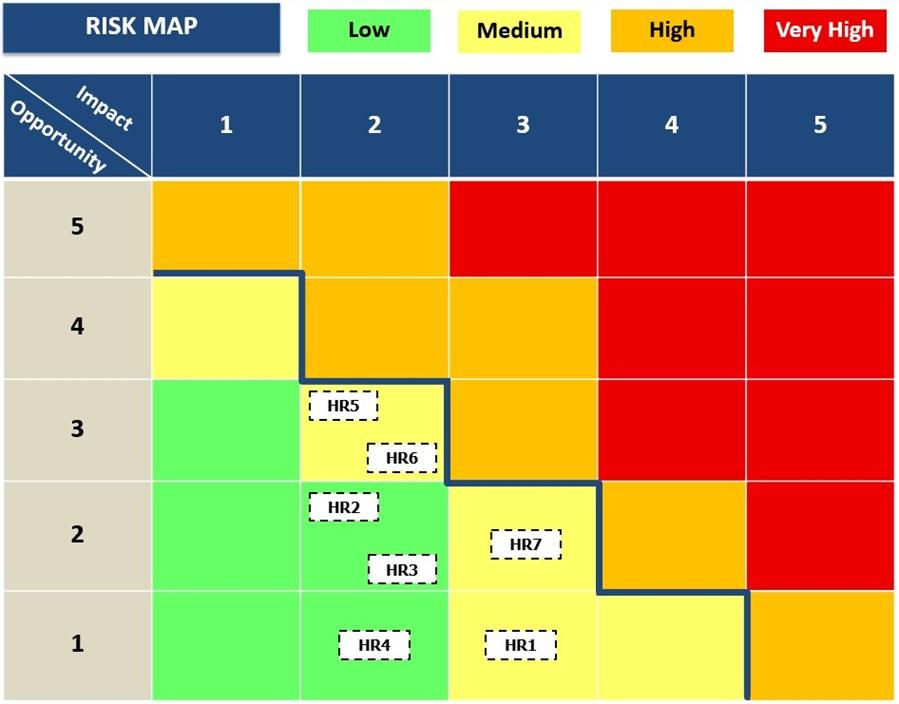
Very High Risk (VH) : Unacceptable risk. Requires a mitigation plan or other measures (e.g., strategic adjustments or operational changes) to specifically address and improve the situation, with close monitoring by relevant management.
High Risk (H) : Unacceptable risk. Requires a mitigation plan and continuous monitoring of implementation results.
Medium Risk (M) : Acceptable risk. No mitigation plan required, but effectiveness of internal controls should be monitored and risk levels reviewed periodically.
Low Risk (L) : Acceptable risk. No mitigation plan required. Risks can be managed with caution and careful supervision during normal operations.
Opportunity/Vulnerability
Level | Details |
1 | Standardized policies, regulations, and operating procedures are established and strictly implemented. The risk is well managed, supported by consistent monitoring and evaluation. |
2 | Standard policies, regulations, or operating procedures are established and implemented. The risk is managed effectively to a considerable extent, with ongoing monitoring and evaluation |
3 | Policies, regulations, or operating procedures are established and implemented. The risk is managed to some extent, with monitoring and evaluation carried out on an occasional basis. |
4 | Policies, regulations, or operating procedures are established and implemented; however, the risk cannot be effectively managed. Monitoring and evaluation are carried out on an occasional basis. |
5 | No policies, regulations, operating procedures, or measures have been established or implemented. Consequently, the risk cannot be managed, and there is no monitoring or evaluation in place. |
Assessment of Impacts on Core Business
Impact Assessment | Operations | Financial | ESG | Reputation |
Weight (%) | 30% | 30% | 20% | 20% |
Operation
Level | Details |
1 |
|
2 |
|
3 |
|
4 |
|
5 |
|
Financial
Level | Details |
1 | Damage value not exceeding THB 1 million |
2 | Damage value from THB 1 million up to but not exceeding THB 2 million |
3 | Damage value from THB 2 million up to but not exceeding THB 3 million |
4 | Damage value from THB 3 million up to but not exceeding THB 10 million |
5 | Damage value exceeding THB 10 million |
ESG
Level | Details |
1 |
|
2 |
|
3 |
|
4 |
|
5 |
|
Reputation
Level | Details |
1 |
|
2 |
|
3 |
|
4 |
|
5 |
|
5. Risk Mitigation and Preventive Mechanisms
The Company communicates relevant policies and practices to all stakeholders as follows:
Human Rights Policy
Channels for Human Rights Contact and Complaints
Annual compliance review of policies and guidelines, conducted at least once a year in accordance with the audit plan
6. Remediation
The Company recognizes the importance of remediation and mitigating potential impacts arising from operations, particularly in cases related to community rights. Clear channels have been established for receiving complaints and gathering feedback, as outlined in the Human Rights Policy published on the Company’s website.
The Company places emphasis on individuals who may be affected by community rights issues, by providing channels for complaints, feedback, whistleblowing, and ensuring protective measures for whistleblowers and complainants. These measures are clearly stated in the Human Rights Policy and disclosed on the Company’s website.
In the event of human rights violations resulting from business operations, affected parties will be compensated through appropriate, fair, and lawful processes. Corrective action plans and preventive measures are also implemented to avoid recurrence in the future.
In 2025, the Company recorded no complaints related to human rights violations, reflecting its ongoing and effective commitment to human rights standards.
7. Conclusion
From the human rights risk assessment, it is concluded that all risks are acceptable. The assessment identified three risks at a low level and four risks at a medium level. Although medium-level risks are considered acceptable and do not require formal risk mitigation plans, the Company continues to monitor the effectiveness of related internal controls and regularly reviews the risk levels.
Employees — Plan & Guidelines
Has an Employee Management Plan
Yes
Plan Description
1. Fair Employee Compensation
The Company places importance on establishing appropriate compensation and benefits in line with industry standards and labor laws, to foster motivation and job security. Salary structures and performance-based rewards are reviewed and adjusted transparently.
2. Employee Training and Development
The Company provides both internal and external training programs to continuously enhance employees’ skills, knowledge, and potential. This includes developing future leaders and promoting digital and financial literacy to keep pace with business and capital market changes.
3. Employee Relations and Engagement
The Company encourages open and constructive internal communication and organizes activities to strengthen employee relationships, such as recreational events, CSR initiatives, and forums for idea exchange, ensuring employees feel engaged and part of the Company’s success.
4. Migrant Workers
The Company strictly complies with labor laws and relevant regulations, emphasizing lawful employment of migrant workers. Equal rights and benefits are provided to ensure fairness and reduce inequality.
5. Child Labor
The Company maintains a clear policy against child labor and enforces strict employment verification measures to ensure all employees meet the legal age requirements and receive appropriate protection of their rights.
6. Occupational Health and Safety
The Company prioritizes a safe working environment by providing regular safety and occupational health training, implementing protective equipment and accident prevention measures, and conducting workplace risk assessments to ensure employees can work with confidence and safety.
Plan Areas
| Plan Area |
|---|
| Fair employee compensation |
| Employee training and development |
| Promoting employee relations and participation |
| Migrant/foreign labor |
| Child labor |
| Occupational health and safety in workplace |
Employees — Workforce
Workforce Data
| Metric | Current Year | Previous Year | Two Years Ago |
|---|---|---|---|
| Total number of employees (Persons) | 824 | 668 | 986 |
| Number of male employees (Persons) | 544 | 439 | 667 |
| Number of female employees (Persons) | 280 | 229 | 319 |
| Total employment of disabled persons (people) | 3 | 3 | 3 |
| Total disabled employees (people) | 3 | 3 | 3 |
| Total male disabled employees (people) | 3 | 3 | 3 |
| Total female disabled employees (people) | 0 | 0 | 0 |
| Total disabled workers who are non-employee (people) | 0 | 0 | 0 |
| Contributions to the fund for promoting and improving the quality of life for disabled persons | 1 | 1 | 1 |
| Total number of male employees in operational level (Persons) | 451 | 355 | 566 |
| Total number of male employees in management level (Persons) | 75 | 67 | 83 |
| Total number of male employees in executive level (Persons) | 18 | 17 | 18 |
| Total number of female employees in operational level (Persons) | 248 | 196 | 284 |
| Total number of female employees in management level (Persons) | 18 | 20 | 22 |
| Total number of female employees in executive level (Persons) | 14 | 13 | 13 |
Employees — Remuneration & Provident Fund
Remuneration & Provident Fund
| Metric | Current Year | Previous Year | Two Years Ago |
|---|---|---|---|
| Total disabled employees (people) | 273,671,960.98 | 268,545,360 | 316,992,628.45 |
| Total male employee remuneration (Baht) | 183,168,606.08 | 179,642,798 | 218,987,699.57 |
| Total female employee remuneration (Baht) | 90,503,354.9 | 88,902,562 | 98,004,928.88 |
| Number of employees eligible to participate in PVD (persons) | 23 | 23 | 27 |
| Total number of employees joining employee provident fund (Persons) | 23 | 23 | 27 |
| Percentage of total number of employees joining employee provident fund to total number of employees (%) | 2.79 | 3.44 | 2.74 |
| Number of PVD members / Total eligible employees (%) | 100 | 100 | 100 |
| Total amount of provident fund contributed by the Company (Baht) | 213,073.56 | 223,073.97 | 247,606.26 |
| Total amount of provident fund contributed by employee (baht) | 213,073.56 | 223,073.97 | 247,606.26 |
Employees — Training & Development
Training Data
| Metric | Current Year | Previous Year | Two Years Ago |
|---|---|---|---|
| Average employee training hours (Hours / Person / Year) | 6 | 6 | 6 |
| Employee development and training expenses (baht) | 735,980 | 7,892 | 809,302.2 |
Employees — Occupational Health & Safety
Occupational Health & Safety Data
| Metric | Current Year | Previous Year | Two Years Ago |
|---|---|---|---|
| Total number of lost time injury incidents by employees (Cases) | 1 | 0 | 0 |
Employees — Labour Relations
Labour Relations Data
| Metric | Current Year | Previous Year | Two Years Ago |
|---|---|---|---|
| Proportion of voluntary resignations (%) | 40 | 331 | 326 |
| Total voluntary resignations (Persons) | 40 | 331 | 326 |
| Male employees who voluntary resigned (Persons) | 25 | 236 | 230 |
| Female employees who voluntary resigned (Persons) | 15 | 95 | 96 |
| Percentage of employee turnover leaving the Company voluntarily (%) | 4.85 | 49.55 | 33.06 |
| Evaluation result of employee engagement | 0 | 0 | 0 |
Employees — Employee Representation
Employees Are Represented Collectively
No
Employees — Targets
Has Set Employee Targets
Yes
Targets
| Indicator | Target Areas | Base Year | Base Year — Description | Target Year | Target Year — Description |
|---|---|---|---|---|---|
| Number of employees who participated in both internal and external training programs. Providing scholarships and merit-based academic grants. | 2990 · Other name: Providing scholarships and merit-based awards to employees' children. · Description: Others · 2984 · Description: Employee training and development | 2,024 | A total of 736 employees participated in training programs.
Scholarships and merit-based awards are provided to the children of employees. | 2,025 | A total of 1,009 employees participated in training programs.
Scholarships and merit-based awards continue to be provided to employees' children. |
Employees — Performance & Outcomes
Has Performance Results
Yes
Performance Description
Training programs were organized to enhance employees’ knowledge and competencies both internally and externally. In 2025, the company arranged training sessions covering work-related skills, occupational safety and health, workplace environmental practices, communication on anti-corruption measures, and other areas. A total of 1,009 employees participated, comprising 166 at the management level, 194 at the supervisory level, and 649 at the staff level.
Provide scholarships and outstanding scholarships to employees' children, totaling 515 scholarships, divided into 109 outstanding scholarships for children of employees with a grade of 3.5 up studying in primary, secondary, and tertiary levels, and 406 scholarships for employees' children, a total amount of which was 662,400 Baht.
Customers — Plan & Guidelines
Has a Customer Management Plan
Yes
Plan Description
1. Responsible Production and Services for Customers
The Company emphasizes delivering quality, transparent, and fair products and services, guided by the principles of Good Governance to build customer trust. Service standards are regularly reviewed, and processes are continuously improved to comply with regulatory requirements, ensuring safe and reliable services for customers.
2. Communication of Product and Service Impacts to Customers/Consumers
The Company provides accurate, comprehensive, and easily understandable information to customers regarding service conditions, potential impacts, and benefits. Multiple communication channels are utilized, including the website, applications, and contractual documents, enabling customers to make well-informed and transparent decisions.
3. Enhancing Customer Satisfaction and Relationship Building
The Company prioritizes creating positive customer experiences by conducting regular satisfaction surveys and using the results to improve services continuously. Relationship-building activities are also organized, such as customer privilege programs, financial advisory services, and customer support during changing economic conditions, fostering long-term trust and loyalty.
4. Customer Data Protection
The Company recognizes the importance of safeguarding personal data and strictly complies with the Personal Data Protection Act (PDPA). Robust data security systems are implemented, with access rights restricted to authorized personnel. Employees are trained to understand and comply with data protection measures, ensuring customer confidence in the Company’s practices.
Plan Areas
| Plan Area |
|---|
| Responsible production and services for customers |
| Communication of product and service impacts to customers/consumers |
| Development of customer satisfaction and customer relationship |
| Protection of customer personal information |
Customers — Satisfaction Results
Customer Satisfaction Results
| Metric | Current Year | Previous Year | Two Years Ago |
|---|---|---|---|
| Evaluation results of customer satisfaction | 0 | 0 | 0 |
Customers — Targets
Has Set Customer Targets
Yes
Targets
| Indicator | Target Areas | Base Year | Base Year — Description | Target Year | Target Year — Description |
|---|---|---|---|---|---|
| Number of customers who downloaded the TK Plus and TK Line applications. Number of customer complaint cases. | 3008 · Description: Communication of product and service impacts to customers/consumers · 3010 · Description: Consumer data privacy and protection | 2,024 | There are 39,855 active customers who have downloaded the TK Plus and TK Line applications.
No customer complaints were received. | 2,025 | There are 21,400 active customers who have downloaded the TK Plus and TK Line applications, a decrease from 2024 due to the company’s slowdown in loan disbursement, which resulted in a reduction of outstanding borrowers.
No customer complaints were received. |
Customers — Performance & Outcomes
Has Performance Results
Yes
Performance Description
The company communicates accurate, comprehensive, and easy-to-understand information to customers regarding service conditions and benefits through various channels, including the website and mobile applications. This ensures that customers receive complete and useful information, while also providing convenient and efficient means of contacting the company. In 2025, there were 21,400 active customers who had downloaded the TK Plus and TK Line applications, a decrease from 2024 due to the company’s slowdown in loan disbursement, which resulted in a reduction of outstanding borrowers. Among these customers, 77% used the applications to make installment payments.
The company recognizes the importance of personal data protection and strictly complies with the Personal Data Protection Act (PDPA). Measures include implementing data security systems, restricting access rights to authorized personnel only, and providing employee training to ensure proper understanding and compliance with data protection practices. These efforts aim to build customer confidence. In 2025, the company did not receive any customer complaints related to personal data protection.
Community & Social — Plan & Guidelines
Has a Community & Social Plan
Yes
Plan Description
1.The company's executives and staff together donated 143 pairs of school shoes, school supplies, sports equipment, 100 t-shirts, and 30 blankets to Wat Nakhunsaen School in Ratchaburi Province.
2. Organizing blood donation activities 3 times with Siriraj Hospital in which 146 employees donated blood totaling 65,700 CC. to help deliver safe blood to patients in the crisis of COVID-19. TK and its affiliates have continuously organized blood donation activities more than 27 times, total amount of blood donated being 828,450 CC.
Plan Areas
| Plan Area |
|---|
| Occupational health, safety, health, and quality of life |
| Disadvantaged and vulnerable groups |
Community & Social — Targets
Has Set Community & Social Targets
Yes
Targets
| Indicator | Target Areas | Base Year | Base Year — Description | Target Year | Target Year — Description |
|---|---|---|---|---|---|
| Blood Donation Activities Activities to support underprivileged groups. | 3042 · Description: Disadvantaged and vulnerable groups · 3041 · Description: Occupational health, safety, health, and quality of life | 2,024 | Blood donation activities were organized three times.
The company’s executives and employees participated in donation activities to support the underprivileged in Ratchaburi Province. | 2,025 | Blood donation activities were organized three times.
The company’s executives and employees participated in donation activities to support the underprivileged in Ratchaburi Province. |
Community & Social — Performance & Outcomes
Has Performance Results
Yes
Performance Description
1. In 2025, the company’s executives and employees donated 143 pairs of school shoes, educational supplies, sports equipment, 100 T-shirts, and 30 winter blankets to Wat Na Khun Saen School in Ratchaburi Province.”
2. Three blood donation activities were organized in collaboration with Siriraj Hospital, with 146 employees participating. A total of 65,700 cc of blood was collected to provide safe blood for patients in need. TK and its affiliates have continuously organized blood donation activities more than 27 times, with cumulative donations amounting to 828,450 cc as of 2025.
Law Violation Incidents
Law Violation Incidents
| Metric | Current Year | Previous Year | Two Years Ago |
|---|---|---|---|
| The total number of cases or incidents of significant violations of laws or regulations regarding social and human rights (Cases) | 0 | 0 | 0 |
| The total number of cases or incidents that cause significant labor disputes (Cases) | 0 | 0 | 0 |
| The total number of cases or complaints related to consumer rights violations (Cases) | 0 | 0 | 0 |
| The total number of cases or complaints related to partner rights violations (Cases) | 0 | 0 | 0 |
| The total number of cases or incidents that cause disputes with the community/society (Cases) | 0 | 0 | 0 |
| The total number of cases or incidents related to cyber security or customer data breaches (Cases) | 0 | 0 | 0 |
| The total number of cases or incidents related to safety and occupational health at work (Cases) | 0 | 0 | 0 |